Fracturing/pressure pumping

The Seismos full-scale research center opens to industry, universities, and national laboratories, advancing acoustic sensing across upstream energy, pipelines, critical infrastructure, and national security.

This article from the SPE Research and Development Technical Section offers new insights to how the upstream industry can benefit from the emergence of quantum computing.

This contributed article highlights the growing importance of fiber-optic sensing and its potential to advance thanks to emerging quantum technologies.
-
 This paper presents a newly developed model to predict the breakdown pressures in cased and perforated wells.
 -
As gas development focuses more on tight and ultratight formations, the challenges to produce economically become diverse and more intense. One main challenge faced while fracturing a well is a high fracture gradient.
-
This paper presents a newly designed triaxial fracturing system and describes a series of experiments that verified the validity of tool-free chemical diversion for multistage fracturing of openhole horizontal wells.
-
This paper presents a unique work flow that addresses in real time the challenges of perforation and fracture-treatment design while accounting for the lithologic and stress variability along the wellbore and its surroundings.
-
In this study, a laboratory analysis was conducted to study the effect of a phosphonate-based scale inhibitor on a mixture of hypersaline Arabian Gulf seawater and formation water under high-temperature/high-pressure conditions.
-
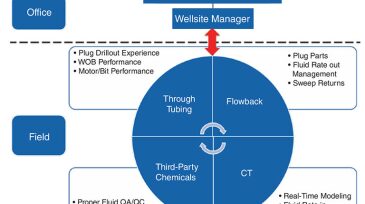
This paper presents a factory-model approach to improving CT drillout performance that has been used successfully for more than 3 years and has become standard practice.
-
This paper contains a detailed discussion of methods and a software tool that has been developed to generate information that predicts formation-face pressures in real time with the help of live bottomhole-pressure data.
-
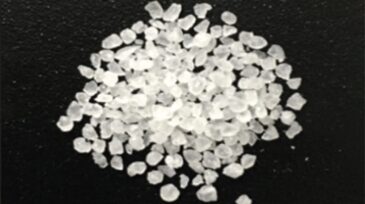
The very first fracturing job used sand scooped from a nearby river. After decades of buying sand based on tight size standards, unconventional operators are increasingly going back to a broad range of sizes, similar to that river sand.
-
In the fast-moving US shale sector, no market trend seems to last long. The pressure pumping market exemplifies the maxim.
-
"I have some patients whose symptoms I can’t explain," physician Ulrike Meyer said, describing nosebleeds, rare cancers, and respiratory illness among a dearth of data.