Fracturing/pressure pumping

The Seismos full-scale research center opens to industry, universities, and national laboratories, advancing acoustic sensing across upstream energy, pipelines, critical infrastructure, and national security.

This article from the SPE Research and Development Technical Section offers new insights to how the upstream industry can benefit from the emergence of quantum computing.

This contributed article highlights the growing importance of fiber-optic sensing and its potential to advance thanks to emerging quantum technologies.
-
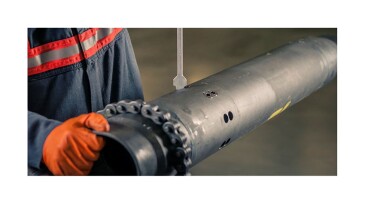
 This paper discusses the development of a multientry, multistage fracturing system and its advantages over traditional openhole multistage fracturing solutions.
 -
Industry leaders champion collaborative solutions as essential for overcoming fracturing limitations.
-
Three graduate students have received the 2025 SPE Hydraulic Fracturing Technology Conference and Exhibition Outstanding Graduate Student Award.
-
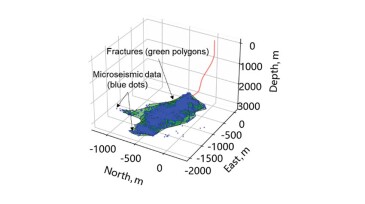
In this paper, an energy-based 3D fracture-reconstruction method is proposed to derive the complex fracture network from microseismic data in a shale gas reservoir.
-
This selection of cutting-edge articles spotlights how experimental concepts are now driving cost-saving strategies in unconventional development. It’s a reminder that innovation often comes from creative thinking, not just new tools or tech partnerships.
-
A novel approach uses the heart-shaped signal in low-frequency distributed acoustic sensing measurements to estimate the hydraulic fracture tip distance before the hydraulic fracture intersects the monitor well, offering critical insight into the characterization of hydraulic fracture propagation.
-
At SPE’s Permian Basin Energy Conference, operators shared behind-the-scenes details on innovations such as drilling horseshoe wells and trimulfrac completions along with in-basin challenges such as handling produced water.
-
This paper presents a specialized workflow that aims to quantify the severity of condensate banking and subsequently optimize reservoir development strategies for a deep formation in the Permian Basin.
-
This paper describes numerical modeling studies of fracture-driven interactions using a coupled hydraulic-fracturing-propagation, reservoir-flow, and geomechanics tool.
-
The papers highlighted in this section demonstrate the merging of the theoretical and empirical to solve practical problems, addressing topics such as casing deformation, condensate banking, and mitigation of fracture-driven interactions.