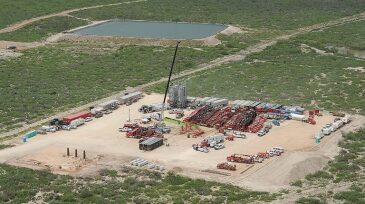
Fracturing/pressure pumping

Output is rising fast in the South American shale play and putting Argentina on a course to soon reach 1 million B/D.

This case study presents a procedure in which the operator compared production from wells with adjusted wettability to a control group, finding that the adjustments resulted in significant improvements in production and reductions in produced water.

This paper presents findings reinforcing the argument that acid fracturing is a strong alternative stimulation method to improve productivity in the Austin Chalk formation.
-
 This paper aims to develop criteria for identifying situations in which induced fracture complexity and sustained conductivity are or are not required.
 -
This study provides a model for the inclined fracture case. It applies and further extends the unified-fracture-design approach for rectangular drainage areas, relating the dimensionless proppant number to the maximum productivity index in pseudosteady-state conditions.
-
The lower tertiary formation found in the pre-salt layers of the Gulf of Mexico has become a proving ground for extending what is possible when completing multistage fracturing in ultradeepwater wells.
-
Southwestern Energy plans to be freshwater neutral in its hydraulic fracturing operations by next year, and the company is well on its way to achieving that goal, said the leader of the group responsible for bringing it to fruition.
-
You have probably heard that the Eskimo language has several dozen words for “snow,” a frequently repeated and well-known idea. It is untrue. A meme is a snippet of culture that is learned by imitation and passed on by imitation or repetition.
-
The United States’ liquids-rich shale experience has been dominated by three major plays: the Eagle Ford Shale in south Texas, the Permian Basin in west Texas, and the Bakken Shale that straddles North Dakota and Montana.
-
The ultimate performance of fractured wells in tight reservoirs is affected severely by the interfering effects inside the fracture and interfractures.
-
Drilling long horizontal wellbores and completing wells with multistage fracturing are common practices in shale-play development.
-
Companies are deploying a variety of technologies to reduce the water needs of hydraulic fracturing. Where are these new facilities with these new technologies, and how will they help operators solve the problem of finding water to use?
-
Hydraulically fracturing and stimulating multiple horizontal wells in sequence has been rapidly adopted by operators because of the potential for production without introducing unwanted risks.