HSE & Sustainability

SPE’s newly renamed Safety Technical Section expands the reach of human factors by integrating safety, risk management, and system resilience expertise while preserving dedicated leadership and technical focus.

As drilling operations become increasingly digital, computer vision is emerging as a continuous safety layer that complements, not replaces, established safety practices. The challenge is no longer whether artificial intelligence can detect hazards, but how operators should deploy, integrate, and govern these systems to improve safety without adding operational comple…

New geothermal technical content and programming will highlight knowledge transfer among oil and gas and geothermal professionals.
-
 The collaboration will see TGS’ software platform implemented throughout the carbon value chain at the Northern Lights project.
 -
The new report shows that the intensity of methane emissions in the Permian Basin declined by more than half over 2 years.
-
With Brazil enacting South America’s first carbon capture and storage (CCS) law, this article examines the technical and regulatory architecture required to scale CCS deployment and provides exclusive insight into Brazil’s accelerating CCS landscape.
-
This paper describes a risk-based self-verification process conducted through a bespoke software application.
-
This paper discusses and demonstrates the limitations of quantitative risk assessment (QRA) with respect to the usefulness of the concept in managing day-to-day and emerging risks as well as the effect of change.
-
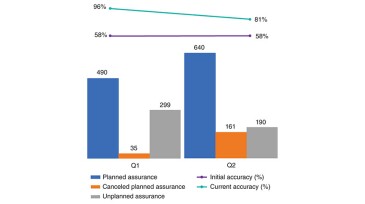
This paper describes a tool that complements predictive analytics by evaluating top health, safety, and environment risks and recommends risk-management-based assurance intervention.
-
The updates remove some requirements from two grant programs in an attempt to speed up the application process.
-
A new paper from researchers at Heriot-Watt University outlines key advances in chemistry that are driving the push in carbon capture technology.
-
The companies have signed an agreement to deliver carbon captured using Shell’s Cansolv system.
-
The North Sea project will transport and permanently store up to an initial 4 million metric tons of carbon dioxide per year, with startup expected in 2028.