HSE & Sustainability

Modeling solubility trapping at reservoir scale remains a key challenge for carbon storage projects. This study introduces a novel sub-grid convective mixing model, implemented in the Open Porous Media Flow simulator and applied to the SPE11 benchmark, that enables accurate prediction of carbon dioxide dissolution trapping in geological storage using computationally e…

SPE’s newly renamed Safety Technical Section expands the reach of human factors by integrating safety, risk management, and system resilience expertise while preserving dedicated leadership and technical focus.

As drilling operations become increasingly digital, computer vision is emerging as a continuous safety layer that complements, not replaces, established safety practices. The challenge is no longer whether artificial intelligence can detect hazards, but how operators should deploy, integrate, and govern these systems to improve safety without adding operational comple…
-
 The upstream oil and gas sector alone could cut as much as 4% of global greenhouse-gas emissions, according to a report from McKinsey. But this will take worldwide cooperation among industry players and capital investors.
 -
This paper presents a method of geomechanical-risk screening and gives examples of its positive effect on the company’s safety standards through implementation of integrated solutions to prevent or mitigate the risks.
-
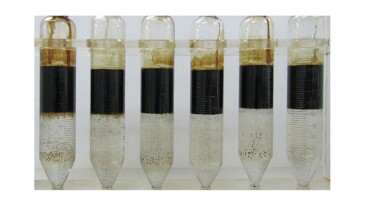
Sharing state-of-the-art design and troubleshooting methods, the workshop identified future separation needs and gap statements and proposed how to close the gaps.
-
This work investigates a cost-effective and sustainable alternative to acidification for sheen control.
-
The authors of this paper discuss how intelligent completions in the Gulf of Mexico have allowed for increased production, reduction in operating expenses, enhanced overall reservoir recovery, and improved safety and environmental performance.
-
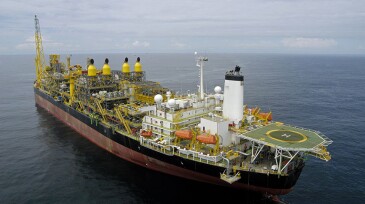
This paper presents the operator’s learnings in evaluating the routine of a floating production, storage, and offloading asset crew to identify scenarios for the application of robotics in day-to-day offshore activities.
-
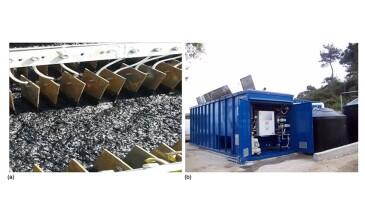
The paper aims to address the challenges and opportunities in managing produced water and its contaminants in the petroleum industry.
-
This paper describes the development of guidelines to determine the most suitable corrosion-resistant alloys for downhole injection equipment in wells for carbon capture and storage and carbon capture, use, and storage.
-
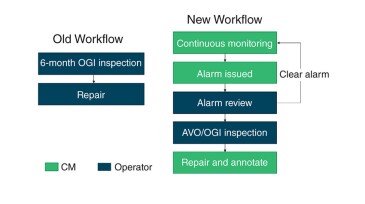
This paper examines how data-science-driven work practices can result in substantial reductions in methane emissions compared with other leak-detection and -repair methods.
-
The industry no longer considers the water as only a logistical problem. Now, it is a front-and-center component of any life-cycle planning.