MPD/UBD

As managed pressure drilling gains traction, its principles are influencing a wider range of well-construction activities.

A report commissioned by Havtil, the Norwegian Ocean Industry Authority, calls for better dialogue regarding pore-pressure uncertainty and higher-end drilling techniques like managed pressure drilling as methods to reduce the risk of well-control events.

Autonomous drilling through managed pressure drilling (MPD) at the Atlantis field has given the operator confidence to scale the method.
-
 This paper describes challenges faced in a company’s first deepwater asset in Malaysia and the methods used to overcome these issues in the planning stage.
 -
This paper discusses the successful application of managed-pressure drilling (MPD) in the basin with reduction in risks and well costs.
-
This paper describes the drilling of high-pressure/high-temperature (HP/HT) deepwater wells through an ultranarrow pore-pressure fracture gradient (PPFG) window by means of technology application and strict procedural control.
-
This paper discusses how managed-pressure-drilling (MPD) technology led to cost savings in two wells drilled in the Hai Thach gas field offshore southern Vietnam.
-
This paper describes how a technique known as applied-surface-backpressure managed-pressure drilling (ASBP-MPD) can alleviate the limitations of conventional deepwater well control.
-
The complete paper describes a recent directional coiled-tubing drilling (DCTD) job completed for an independent operator in the Appalachian Basin.
-
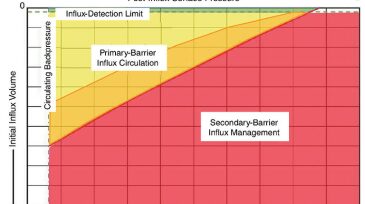
The influx-management-envelope (IME) concept is an advanced, innovative way to assess influx conditions in managed-pressure-drilling (MPD) operations, offering an improved tool for the decision-making process.
-
An early commitment to integrate MPD into an HP/HT drilling operation can make MPD more than just an enabling tool and turn it into a performance tool that offers significant operational benefits.
-
An early commitment to integrate MPD into an HP/HT drilling operation can make MPD more than just an enabling tool and turn it into a performance tool that offers significant operational benefits.
-
This paper details the operational effects of closed-loop drilling to demonstrate its ability to yield operational-process-safety improvements and cost savings over conventional methods.