Onshore/Offshore Facilities

War‑related infrastructure damage is beginning to influence global energy supply chains in ways that could reshape project development and capacity growth.
Sulzer and JSIL are teaming up to provide the service for oil and gas, power generation, and industrial operations.

The deal includes Waygate’s inspection portfolios and is expected to close later this year.
-
 This paper provides details of comprehensive computational-fluid-dynamics (CFD) -based studies performed to overcome the separation inefficiencies experienced in a large-scale three-phase separator.
 -
This paper highlights the issues and challenges surrounding pipeline trenching and burial in ice-gouge environments. The current state of practice is discussed along with the technology gaps that need to be addressed.
-
Bridging the gap between facilities and reservoir engineers is critical in designing systems that are flexible enough to allow a spectrum of reservoir feed conditions to be accommodated over the life cycle of the field. While subsurface uncertainties can't be eliminated, they can be managed.
-
Recent activities around career planning for facilities engineers led me to a list of "must read" books. The recent ATCE generated two revelations. As an industry, we do a poor job of managing major capital projects, and we do not know how to design separators.
-
At the end of the day, when you are working with heavy oil, the question is how to design your system, including both the layout and the functional aspects of various equipment.
-
Operators’ demands for structural designs are changing along with the need to produce from harsher environments, deeper waters, remote areas, and marginal fields. New-builds and modifications require different approaches in assessment of cost, design, and construction.
-
A realistic computational fluid dynamics (CFD) simulation of a field three-phase separator has been developed. Further, a useful approach to estimating the particle size distribution in oilfield separators was developed. The predicted separation efficiencies are consistent with oilfield experience.
-
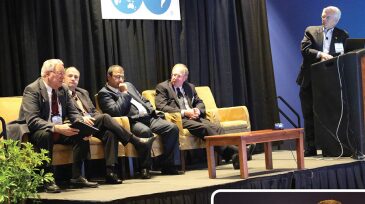
ATCE included expanded content for project, facilities and construction professionals. Panels discussed our performance in managing megaprojects and our challenges in designing separation equipment. Two technical paper sessions were also included.
-
Fluid flows in separation vessels are key to effective performance. The flow distributions are affected by the vessel, the configuration of its internals, and the layout of the upstream piping connecting to the vessel’s inlet nozzle.
-
The market for subsea vessel operations in field development; inspection, repair, and maintenance (IRM); and subsea well intervention is expected to grow 63% during 2012 to 2016.