Onshore/Offshore Facilities

Argentina’s President Javier Milei met with TotalEnergies CEO Patrick Pouyanné and Eni CEO Claudio Descalzi in Paris to discuss Argentina’s energy sector, including projects linked to the Vaca Muerta shale formation and the development of the Argentina LNG export project.

The Absheron gas field expansion will supply additional natural gas to Azerbaijan’s domestic market and support its export commitments to Turkey, allowing Baku to stay focused on meeting its gas export obligations to Europe.
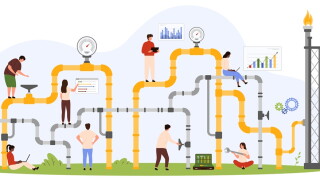
A credible custody-transfer record depends on far more than the accuracy of a single meter. It is the product of an integrated measurement chain. While meter performance supports measurement-system integrity, commercial confidence also depends on traceability, governance, and authorization.
-
 This paper is investigates installed cost overruns of pipeline-compressor-station projects, using data from more than 200 projects. Results of the analysis show that project size, capacity, location, and year have different impacts on individual component overruns.
 -
Valuation of the enhanced flexibility offered by platform-based development solutions and sequential subsea solution is difficult. This leads to the question: Are development solutions being selected without taking sufficient account of option values?
-
My, what a difference a year makes as I look back at last year’s interest vs. this year’s. Improved-oil-recovery (IOR) technology and remotely-operated-vehicle support were in the forefront last year. This year, the buzz is around high pressure/high temperature (HP/HT). This is not to say that IOR technology has vanished or become passé; far from it. But this year’s g…
-
The design of subsea equipment for pressures greater than 15,000 psi and temperatures more than 250°F is a substantial challenge. The current standard from the American Petroleum Institute (API), Specification 17D, for designing subsea equipment provides little guidance on conditions exceeding these measurements. This work has been performed to demonstrate the accepta…
-
As the need for oil and gas equipment working in hotter and higher-pressure environments continues to mount, the effort to develop an adequate set of design, material, and validation practices continues to be challenging. More-rigorous stress analysis and design methods that more closely model fast-fracture burst conditions are needed to achieve safe, reliable, and co…
-
A program was devised to test the manufacturability of shrink-fit joints made from high-strength (greater than 100 ksi) mill pipe and forged couplings.
-
Gas production in the South China Sea has seen an increasing trend of pipelines operating in high-pressure, high-temperature (HP/HT) conditions. This has led operators to look beyond the conventional stress-based design and move into strain-based design using the lateral-buckling-design approach. This paper presents both construction challenges and operational works p…
-
Many two-phase and three-phase separators in the oil and gas industry continue to underperform. This article explores the weaknesses in different sizing methodologies and proposes manageable approaches to quantifying each.
-
In an SPE webinar, “Foaming in Separators: Handling and Operation,” Wally Georgie, principal consultant at Maxoil Solutions, presented an overview of foam generation and how the design of processes and chemical management can exacerbate its detrimental effects in separators.
-
The effects of turbulence/shear and thermal driving force on wax-deposition characteristics were experimentally studied using a waxy crude oil from the Gulf of Mexico.