Processing systems/design

Despite significant progress in capturing associated gas for domestic use, Iraq remains the world’s third-largest gas-flaring country as it aims for higher oil and gas production targets.

This article addresses the challenges of managing water-soluble organics (WSOs) in offshore produced water. It provides a brief discussion of the chemistry, along with strategies and technologies that can be used to manage WSO levels in produced water, thus facilitating compliance with regulatory overboard water-quality guidelines.

The new technology, recently highlighted at OTC, has received a statement of maturity from ABS.
-
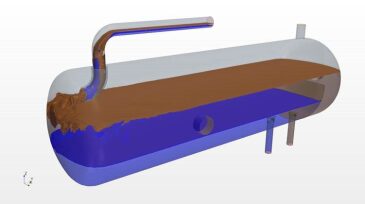
 Why CFD should be part of your separator design? This goal of this goal is to allay any fears about CFD that you may have as a result of flashbacks to university class and a dizzying array of partial-differential equations.
 -
Despite the currently deteriorating oil and gas prices, natural gas, the “least carbon-intensive” fossil fuel, is still projected by ExxonMobil, the International Energy Agency, and other sources to grow by 65% from 2010 to 2040
-
The sources and magnitude of shear and the effects on oil droplet size can have significant consequences for downstream separation equipment performance.
-
Historically, the marine systems on a spar are relatively simple.
-
Lessons learned by the members of the SPE Separations Technology Technical Section, representing more than 250 years' experience, are presented so that the same mistakes are not repeated in the future.
-
The technology described by the authors provides the simplicity of a single-step distillation process for the separation of CO2 from natural gas. The technology has shown the potential to separate CO2 and other impurities from natural gas more efficiently and more cost-effectively.
-
An underperforming scrubber that was suffering from too much oil carry-over is described along with options for debottlenecking and improving performance.
-
Efficient separation assumes uniform flow, but the reality of inlet geometries can invalidate this assumption, leading to separation problems and loss of separation efficiency.
-
Some internals components affect a separator's gas- and liquid-handling capability because of their effects on the liquid level. In this article, the interdependency of cyclonic inlets, cyclonic mist eliminators, and liquid level is highlighted.
-
The paper presents and discusses a solution for immersive training of industrial operators that allows experiencing the multifaceted scenarios of real-plant operations.