R&D/innovation

The startup company’s Midland Basin demonstration plant, located in the Permian Basin, takes a major step toward commercialization by proving its direct lithium extraction technology can refine battery-grade lithium carbonate from produced water under multiple 24/7 production cycles.

This case study outlines a full-scale testing program focused on the behavior of thermal casing connections subjected to severe bending and low-cycle fatigue loading.

This article from the SPE Research and Development Technical Section offers new insights to how the upstream industry can benefit from the emergence of quantum computing.
-
 For deepwater development, panelists at OTC emphasized the need for scalable technology, the standardization and simplification of projects, patient capital investment in innovation, greater collaboration, and new perspectives coming from outside the industry.
 -
Industry's finest minds are expected to come together for an idea summit during the upcoming SPE Intelligent Energy International Conference and Exhibition in Aberdeen.
-
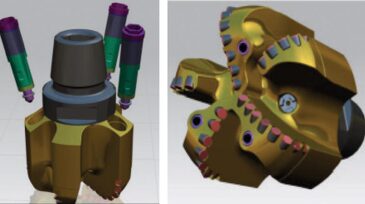
Baker Hughes is developing a drill bit capable of auto-adjusting its depth-of-cut feature to handle dynamic drilling conditions.
-
Low prices require doing things differently. It is a hopeful sign for the future for innovators who have been struggling to keep going and have potential customers with little to spend and a lot to worry about.
-
The upstream industry is undergoing a transformation. Operators and service providers alike are not just tweaking or fine-tuning, they are completely rethinking the way they work.
-
When it comes to hydraulic fracturing, steadiness may not be a virtue. That was the conclusion of a test to see if rapid pump rate variations would lead to greater production than conventionally fractured stages when the pressure was held steady.
-
Understanding how much rock is being stimulated and propped is critical for unconventional producers. New imaging methods using electromagnetic energy or acoustic microemitters could represent a milestone in understanding what is left behind after fracturing.
-
The first brief flight at Kitty Hawk in 1903 did not immediately make the Wright brothers famous; however, within 5 years, enthusiasm for the new technology began to spread around the world. Louis Blériot won a prize for flying over the English Channel in a heavier-than-air craft in 1909, and Charles Lindbergh won the USD 25,000 Orteig prize for the first nonstop flig…
-
National oil companies (NOCs) in the Middle East plan to boost their collaboration efforts in technology applications through a global industry trade organization’s initiative.
-
Sustained low oil prices have not yet had a significant effect on many universities’ research and development programs. For now, money allocated by the oil and gas industry in previous years is still available for many institutions.