Reservoir characterization

Known as Arena, the collaboration aims to improve decision-making across increasingly complex reservoirs and growing volumes of subsurface data.

Three papers are highlighted as the primary contributions because of their broad industry relevance. They focus on improving formation particle-size characterization, expanding the application of openhole gravel packs in depleted and compartmentalized reservoirs, and advancing the understanding of capillary pressure in sand production.

By integrating experimental and mathematical modeling approaches, this work aims to advance the understanding of sand-detachment dynamics and formation instability under varying saturation conditions.
-
 When it comes to fracturing, experts argue about many things, but they agree that fractures do not look like lightning bolts, tree roots, or shattered glass.
 -
A new miniature pressure/temperature sensor comes packaged inside a tough small ball capable of traveling to the bottom of a well while drilling and returning with data on board.
-
Although principal-component analysis (PCA) has been applied widely to reduce the number of parameters characterizing a reservoir, its disadvantages are well-recognized.
-
As the role of reservoir-flow simulation increasingly affects existing operations and field-development decisions, it follows that rigor, fitness, and consistency should be imposed on the calibration of reservoir-flow models to dynamic data through history matching.
-
FEI is a maker of high-powered microscopes whose growth plan in exploration and production includes building a service company.
-
The process of risk and uncertainty reduction in unconventional-drilling operations starts with improving techniques for pore-pressure modeling.
-
To achieve optimal production from unconventional reservoirs, it is useful to determine the permeability, pore pressure, and state of stress of rock strata.
-
Add a new possible use for downhole casing: It can serve as broadcast antennae.
-
The development of an economically efficient drilling program in shale-gas plays is a challenging task, requiring a large number of wells; even with many wells, the average well production and the variation of well performance (economics) remain highly uncertain.
-
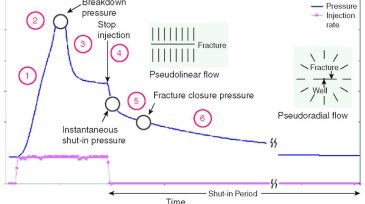
This paper attempts to describe some of the common problems and to help prevent some common errors often observed in diagnostic fracture injection tests (DFITs) execution and analysis.