Reservoir characterization
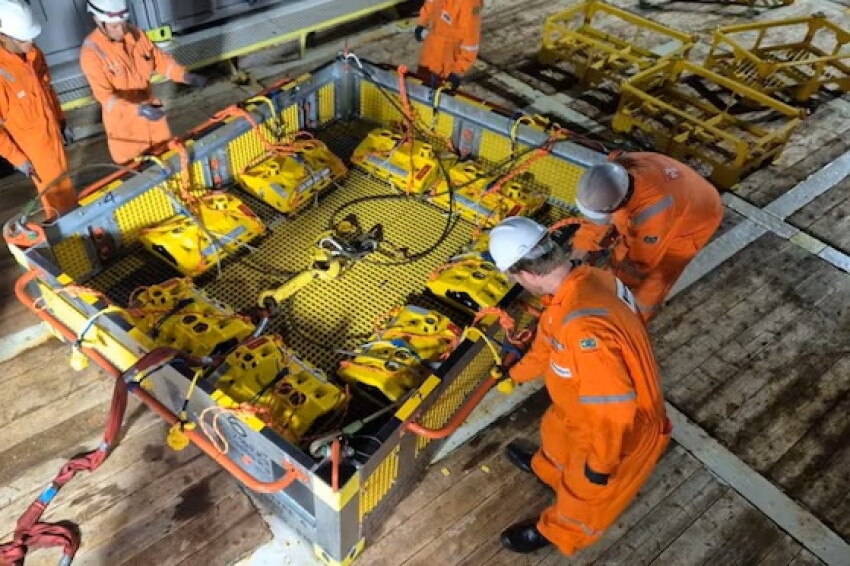
The technology has passed its first phase of qualification, with 84 nodes placed on the seafloor at a depth of 2,000 m to acquire 4D seismic data in the pre-salt Santos Basin.

Xu outlines the thinking and theories that led his team to six world-class oil discoveries that total more than 100 million tons of proven geological reserves since 2021.

This case study from SLB and offshore producer PRIO describes the longest openhole section in Latin America with the highest extended-reach drilling ratio in Brazil’s history.
-
 A new miniature pressure/temperature sensor comes packaged inside a tough small ball capable of traveling to the bottom of a well while drilling and returning with data on board.
 -
Although principal-component analysis (PCA) has been applied widely to reduce the number of parameters characterizing a reservoir, its disadvantages are well-recognized.
-
As the role of reservoir-flow simulation increasingly affects existing operations and field-development decisions, it follows that rigor, fitness, and consistency should be imposed on the calibration of reservoir-flow models to dynamic data through history matching.
-
FEI is a maker of high-powered microscopes whose growth plan in exploration and production includes building a service company.
-
The process of risk and uncertainty reduction in unconventional-drilling operations starts with improving techniques for pore-pressure modeling.
-
To achieve optimal production from unconventional reservoirs, it is useful to determine the permeability, pore pressure, and state of stress of rock strata.
-
Add a new possible use for downhole casing: It can serve as broadcast antennae.
-
The development of an economically efficient drilling program in shale-gas plays is a challenging task, requiring a large number of wells; even with many wells, the average well production and the variation of well performance (economics) remain highly uncertain.
-
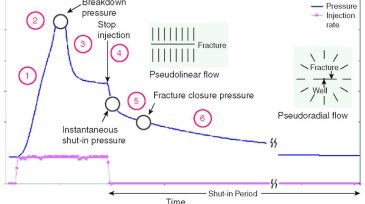
This paper attempts to describe some of the common problems and to help prevent some common errors often observed in diagnostic fracture injection tests (DFITs) execution and analysis.
-
Analytical tools are useful for reservoir management and can provide simplicity while capturing information derived from events occurring at smaller time scales, which are ordinarily sacrificed in numerical simulations to keep run times reasonable.