Reservoir characterization

This paper presents an experiment investigating dissolution of basaltic primary minerals and conditions favorable for secondary phase formation under deep subsurface storage conditions.

This study aims to investigate the efficacy of chemical additives strontium chloride and barium hydroxide in accelerating CO₂ trapping mechanisms, their effect on dissolution of carbonate-bearing minerals, and resulting poroelastic changes in the host rock.

This guest editorial addresses the many capacities in which oil and gas technical professionals can play a role advancing the energy technologies of tomorrow.
-
 SponsoredEffective data analysis depends on seeing connections that matter. Explore how Spotfire enables a more intuitive approach to understanding petroleum data.
 -
This study applies Monte Carlo simulation and an XGBoost regression model to assess the influence of various formations, geologic provinces, tectonic-plate types, and boundary conditions on hydrogen concentrations.
-
This paper presents a novel approach to predict reservoir porosity by conditioning seismic data, calibrating seismic impedance inversion, and tailoring rock-physics analysis.
-
This paper aims to assess the effectiveness of using advanced integrated production-data-analysis techniques for condensate-rich tight gas fields.
-
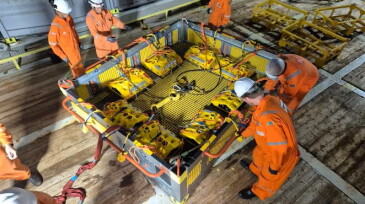
The technology has passed its first phase of qualification, with 84 nodes placed on the seafloor at a depth of 2,000 m to acquire 4D seismic data in the pre-salt Santos Basin.
-
Xu outlines the thinking and theories that led his team to six world-class oil discoveries that total more than 100 million tons of proven geological reserves since 2021.
-
This case study from SLB and offshore producer PRIO describes the longest openhole section in Latin America with the highest extended-reach drilling ratio in Brazil’s history.
-
The company says the service is designed to advance geosteering capabilities in complex drilling environments.
-
The paper describes the revalidation of a deepwater prospect that resulted in a no-drill decision.
-
The objective of this study is to numerically investigate system behavior when storing H2/natural gas (CH4) mixtures in aquifer-related underground gas storage, and the effect of gas composition and salinity on energy-recovery efficiency.