Reservoir characterization

The industry is no longer short of measurements; the real challenge is converting them into timely reservoir decisions that protect value. That challenge is becoming more urgent as the industry depends increasingly on mature fields and existing infrastructure. The selected papers show how this need is being addressed across different producing regions.

This paper presents a case study from a mature field redevelopment project where pulsed neutron logging was integrated with advanced reservoir modeling to improve the understanding of fluid-contact dynamics and optimize new horizontal well placement.

This paper aims to showcase examples of how integrated analysis of surveillance data in the Azeri-Chirag-Gunashli field has improved reservoir understanding and informed reservoir-management decisions.
-
 This study leverages oil-fingerprinting technology and geochemical data to evaluate the fluid connectivity between a main field and its stepout wells.
 -
This paper extends an integrated two-scale continuum model that contemplates mass, momentum, and energy changes to study the acid-stimulation process in complex carbonate acid-stimulation systems with the development of fracture and vug networks.
-
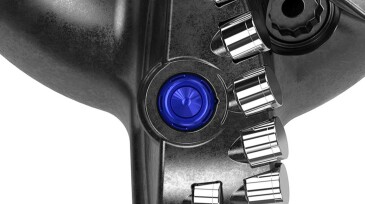
The company’s new Retina imaging system creates high-resolution borehole images at the drill bit.
-
The authors of this paper describe reservoir-fluid-geodynamics processes that explain the reasons behind varying oil compositions and properties within and across different reservoir compartments.
-
Interfacial tension keeps oil and water separate by resisting the mixing of their molecules at the surface. Learn how industry experts measure this force to diagnose fluid behavior.
-
The SPE Reservoir Advisory Committee has updated its "state of the reservoir technical discipline" document. The new edition is available for free download.
-
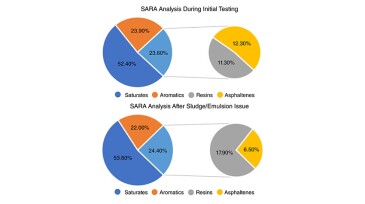
This work investigates the root cause of strong oil/water emulsion and if sludge formation is occurring within the reservoir using a robust integrated approach.
-
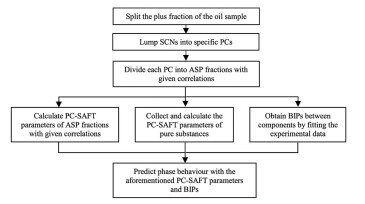
In this work, a perturbed-chain statistical associating fluid theory equation of state has been developed to characterize heavy-oil-associated systems containing polar components and nonpolar components with respect to phase behavior and physical properties.
-
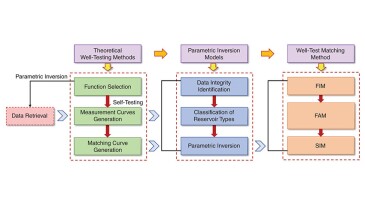
The paper describes a parameter inversion of reservoirs based on featured points, using a semi-iterative well-test-curve-matching approach that addresses problems of imbalanced inversion accuracy and efficiency.
-
After 5 years of in-depth diagnostic research, the Oklahoma City-based operator shares more insights on fracture behavior.