Reservoir simulation

This article from the SPE Integrated Reservoir Management Technical Section (IRMTS) examines the closed-loop IRM approach, from insight to execution to learning, and the limits of technology-driven solutions.

This paper presents a reduced physics-based model that accelerates the ability to screen infill-location optimization, using the fast marching method to maximize production for a reservoir with multiple realizations.

This paper presents a case study from a mature field redevelopment project where pulsed neutron logging was integrated with advanced reservoir modeling to improve the understanding of fluid-contact dynamics and optimize new horizontal well placement.
-
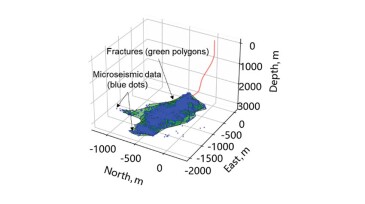
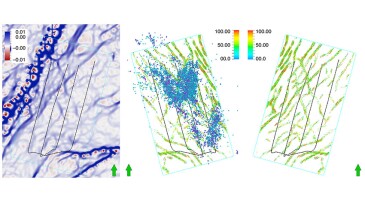
 In this paper, an energy-based 3D fracture-reconstruction method is proposed to derive the complex fracture network from microseismic data in a shale gas reservoir.
 -
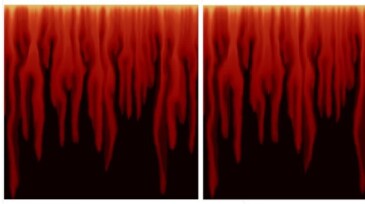
A numerical simulation study based on experimental data of 2D and 3D models is presented to examine immiscible fingering during field-scale polymer-enhanced oil recovery.
-
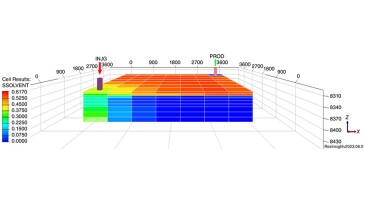
The authors present an open-source framework for the development and evaluation of machine-learning-assisted data-driven models of CO₂ enhanced oil recovery processes to predict oil production and CO₂ retention.
-
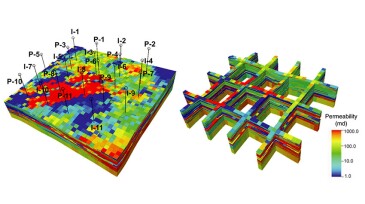
The authors of this paper propose hybrid models, combining machine learning and a physics-based approach, for rapid production forecasting and reservoir-connectivity characterization using routine injection or production and pressure data.
-
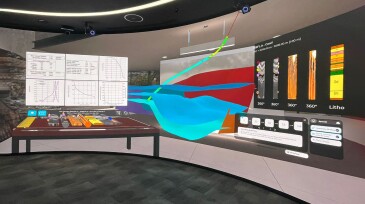
Virtual reality and related visualization technologies are helping reshape how the industry views 3D data, makes decisions, and trains personnel.
-
This paper presents a specialized workflow that aims to quantify the severity of condensate banking and subsequently optimize reservoir development strategies for a deep formation in the Permian Basin.
-
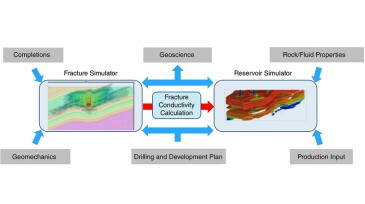
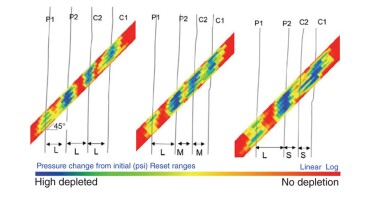
This paper describes numerical modeling studies of fracture-driven interactions using a coupled hydraulic-fracturing-propagation, reservoir-flow, and geomechanics tool.
-
A proposed integrated workflow aims to guide prediction and mitigating solutions to reduce casing-deformation risks and improve stimulation efficiency.
-
This paper presents the processes of identifying production enhancement opportunities, as well as the methodology used to identify underperforming candidates and analyze well-integrity issues, in a brownfield offshore Malaysia.
-
This paper presents a workflow that combines probabilistic modeling and deep-learning models trained on an ensemble of physics models to improve scalability and reliability for shale and tight-reservoir forecasting.