Reservoir simulation

This article from the SPE Integrated Reservoir Management Technical Section (IRMTS) examines the closed-loop IRM approach, from insight to execution to learning, and the limits of technology-driven solutions.

This paper presents a case study from a mature field redevelopment project where pulsed neutron logging was integrated with advanced reservoir modeling to improve the understanding of fluid-contact dynamics and optimize new horizontal well placement.

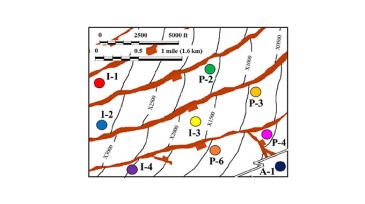
This paper aims to showcase examples of how integrated analysis of surveillance data in the Azeri-Chirag-Gunashli field has improved reservoir understanding and informed reservoir-management decisions.
-
 The authors of this paper describe reservoir-fluid-geodynamics processes that explain the reasons behind varying oil compositions and properties within and across different reservoir compartments.
 -
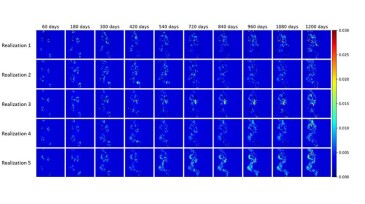
In this study, a deep-neural-network-based workflow with enhanced efficiency and scalability is developed for solving complex history-matching problems.
-
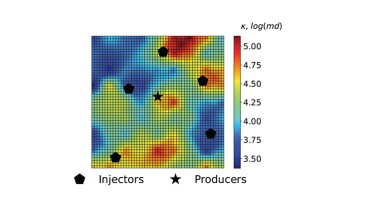
This study presents a production-optimization method that uses a deep-learning-based proxy model for the prediction of state variables and well outputs to solve nonlinearly constrained optimization with geological uncertainty.
-
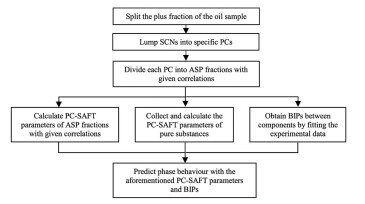
In this work, a perturbed-chain statistical associating fluid theory equation of state has been developed to characterize heavy-oil-associated systems containing polar components and nonpolar components with respect to phase behavior and physical properties.
-
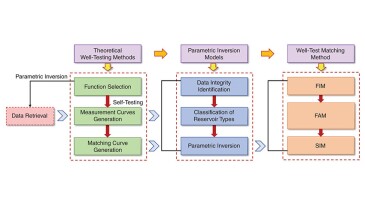
The paper describes a parameter inversion of reservoirs based on featured points, using a semi-iterative well-test-curve-matching approach that addresses problems of imbalanced inversion accuracy and efficiency.
-
This paper introduces a novel optimization framework to address CO2 injection strategies under geomechanical risks using a Fourier neural operator-based deep-learning model.
-
The authors introduce a novel framework combining dynamic mode decomposition, a data-driven model-reduction technique, with direct data assimilation to streamline the calibration of carbon-dioxide plume evolution models.
-
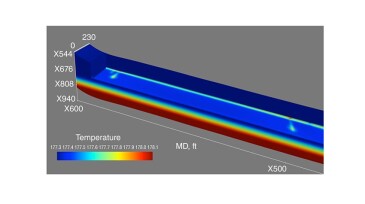
This paper discusses the concept, applications, and continual evolution of a new 3D temperature and spectral-acoustics modeling and logging approach.
-
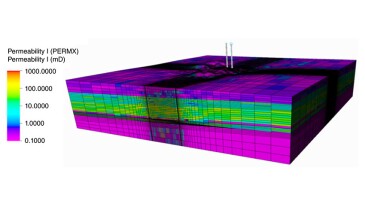
A detailed comparison of two leading software platforms demonstrates the effective application of these platforms in modeling complex reservoir dynamics and biochemical reactions in geological formations for risk assessment in underground hydrogen storage.
-
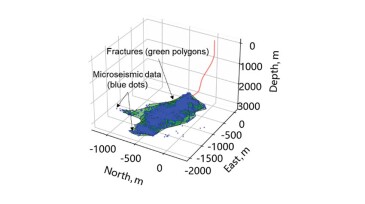
In this paper, an energy-based 3D fracture-reconstruction method is proposed to derive the complex fracture network from microseismic data in a shale gas reservoir.