Reservoir simulation

This article from the SPE Integrated Reservoir Management Technical Section (IRMTS) examines the closed-loop IRM approach, from insight to execution to learning, and the limits of technology-driven solutions.

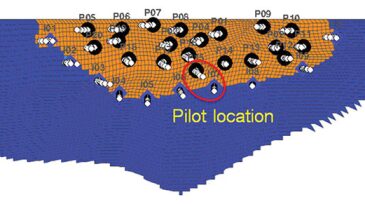
This paper presents a case study from a mature field redevelopment project where pulsed neutron logging was integrated with advanced reservoir modeling to improve the understanding of fluid-contact dynamics and optimize new horizontal well placement.

This paper aims to showcase examples of how integrated analysis of surveillance data in the Azeri-Chirag-Gunashli field has improved reservoir understanding and informed reservoir-management decisions.
-
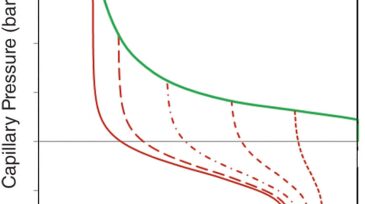
 This paper presents a saturation-modeling approach for fields and reservoirs with complex hydrocarbon-charging histories. The model resolves saturation-height functions for the primary-drainage, imbibition, and secondary-drainage equilibriums.
 -
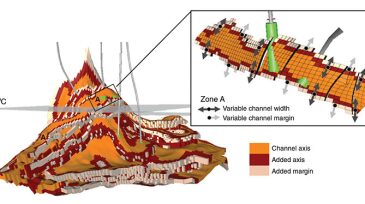
This paper proposes a novel work flow for structural-features modeling that allows the introduction of faults and other structural and nonstructural features to any simulation grid without modification.
-
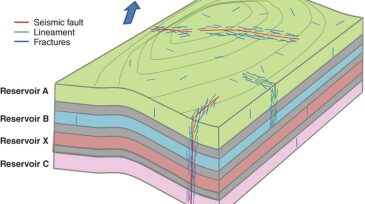
Natural fractures can have a significant effect on fluid flow by creating permeability anisotropy in hydrocarbon reservoirs.
-
A radical digital revolution is happening all around us (or so we are told). Applying this to reservoir simulation, we apparently need to understand better when and, more importantly, when not to use such technology—to appreciate its bounds, its limitations, its range of validity, and so on.
-
SponsoredA Midland Basin case study on estimating production, drainage volume, and interference from multiple stacked wells.
-
An ensemble-based 4D-seismic history-matching case is presented in the complete paper. Seismic data are reparameterized as distance to a 4D anomaly front and assimilated with production data.
-
In the complete paper, the authors propose a novel method to rapidly update the prediction S-curves given early production data without performing additional simulations or model updates after the data come in.
-
The aim of this work is to present the effectiveness of a fully integrated approach for ensemble-based history matching on a complex real-field application.
-
One unfortunate consequence of a base-case model, however, is the risk of an anchoring effect, in which case we may underestimate uncertainty. Essentially, the anchoring effect refers to our tendency to rely too heavily on the information offered, introducing a bias in the model-construction process