Reservoir

Industry experts at URTeC assessed more than a decade of unconventional growth while discussing where productivity gains will come from next.
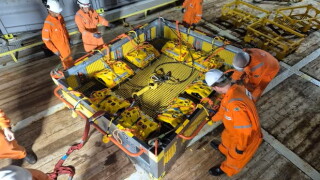
The technology has passed its first phase of qualification, with 84 nodes placed on the seafloor at a depth of 2,000 m to acquire 4D seismic data in the pre-salt Santos Basin.

Chevron and Halliburton describe how they built and deployed the fully autonomous closed-loop fracturing system that enables subsurface-driven optimization.
-
 This paper reviews the efforts to exploit CBM resources in Indonesia, the challenges these efforts have faced, and possible solutions that can make operations more efficient and profitable.
 -
Recently, a lot of discussion has revolved around the benefits of multilaterals in unconventional reservoirs, but is it truly the next breakthrough for the industry, or is it all hype?
-
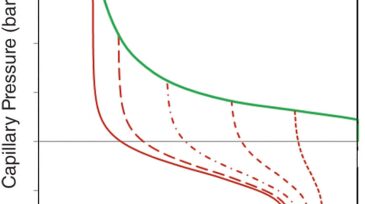
This paper presents a saturation-modeling approach for fields and reservoirs with complex hydrocarbon-charging histories. The model resolves saturation-height functions for the primary-drainage, imbibition, and secondary-drainage equilibriums.
-
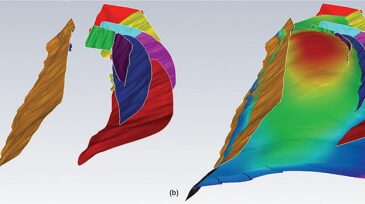
This paper proposes a novel work flow for structural-features modeling that allows the introduction of faults and other structural and nonstructural features to any simulation grid without modification.
-
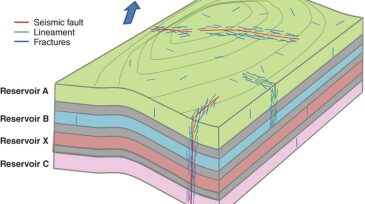
Natural fractures can have a significant effect on fluid flow by creating permeability anisotropy in hydrocarbon reservoirs.
-
A radical digital revolution is happening all around us (or so we are told). Applying this to reservoir simulation, we apparently need to understand better when and, more importantly, when not to use such technology—to appreciate its bounds, its limitations, its range of validity, and so on.
-
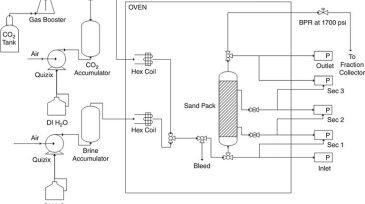
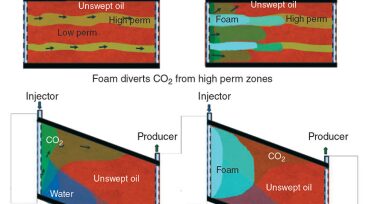
Aqueous foam has been demonstrated to have promise in conformance-control applications. This paper explores the foaming behavior of a CO2-soluble, cationic, amine-based surfactant.
-
A carbon-dioxide (CO2) -foam enhanced-oil-recovery (EOR) pilot research program has been initiated to advance the technology of CO2 foam for mobility control in a heterogeneous carbonate reservoir.
-
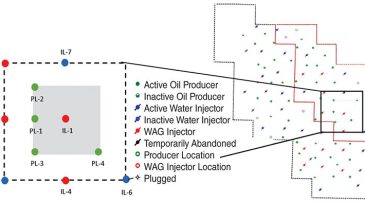
This paper presents an analysis of a CO2-foam-injection pilot in the Salt Creek Field, Natrona County, Wyoming.
-
In my previous features, I discussed the challenges facing carbon dioxide (CO2), both technical and economic. By far the biggest use of CO2 is in enhanced oil recovery (EOR). In this feature, the focus is on overcoming the biggest challenges facing CO2 EOR—gravity override and mobility.