Reservoir

Industry experts at URTeC assessed more than a decade of unconventional growth while discussing where productivity gains will come from next.
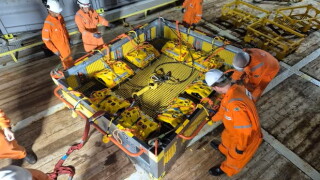
The technology has passed its first phase of qualification, with 84 nodes placed on the seafloor at a depth of 2,000 m to acquire 4D seismic data in the pre-salt Santos Basin.

Chevron and Halliburton describe how they built and deployed the fully autonomous closed-loop fracturing system that enables subsurface-driven optimization.
-
 Researchers: Models Overstate Technology Impact, Understate Location Impact for Unconventional WellsTwo researchers at the MIT Energy Initiative have found that current modeling overestimates the impact of new technology on unconventional well productivity and underestimates that of increasingly targeting reservoir “sweet spots.”
 -
As well-developed shale plays and tight formations mature and decline in production, nontraditional strategies for maximizing production and discovering new resources must be considered.
-
Global emissions of CO2 resulting from the use of fossil fuels amount to approximately 35 billion tons/yr. How much of this can we capture? How much can we store or sequester? And, perhaps the most important question: How much will it cost and who will pay?
-
This paper outlines the key issues that must be addressed from a regulatory perspective in regard to the development of an onshore unconventional-gas industry in the Northern Territory.
-
In unconventional plays, comparing the effect of different completion designs or well-management strategies on well performance remains a challenge because of the relatively brief production history and lack of long-term field analogs of these plays.
-
With multistage operations becoming the industry norm, operators need easily deployable diversion technologies that will protect previously stimulated perforations and enable addition of new ones. This paper reviews several aspects of the use of in-stage diversion.
-
An operator has designed a demonstration project for carbon dioxide (CO2) enhanced oil recovery (EOR) and has implemented it in one of its fields.
-
The Southwest Partnership on Carbon Sequestration (SWP) is one of seven large-scale demonstration projects sponsored by the US Department of Energy.
-
Nearly a decade after an SPE meeting in Bruges set industry-inspiring benchmarks for reservoir modeling, the time has come to overcome a new set of challenges.
-
Conventional inflow-performance-relationship (IPR) models are used in coupled wellbore/reservoir transient simulations, even if bottomhole-pressure conditions are assumed to be constant on the derivation of such IPR models.