Reservoir

This work describes a study in which distributed data parallel training, paired with a node-local caching pipeline, enabled efficient multigraphics-processing-unit scaling for a CO₂-storage graph-neural-network surrogate while maintaining generalization.

This paper presents a study that confirms glass-reinforced-epoxy-lined tubing as a reliable, cost-effective solution for long-term water-injection service in moderate-salinity offshore environments.

This paper presents a novel reservoir engineering/reservoir simulation approach—a data-driven interwell-connectivity model augmented as a digital twin—to predict reservoir dynamics and optimize operations in the Changqing oil field of China.
-
 The service giant shares how its new technology can sense rock properties 50 ft ahead of the bit in horizontal wells.
 -
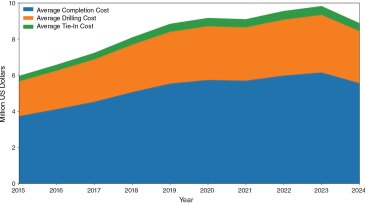
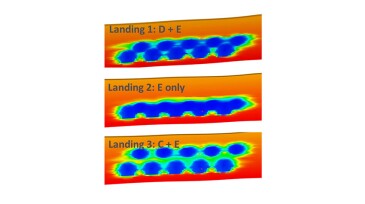
This study aims to thoroughly assess the influence of various completions, fracturing stimulation, and intrinsic reservoir properties affecting the productivity of 10 major unconventional plays while uncovering insights and trends unique to each play.
-
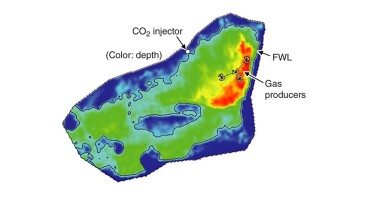
The authors present an efficient workflow using an embedded discrete fracture model to simulate carbon-dioxide flow by use of conductive faults.
-
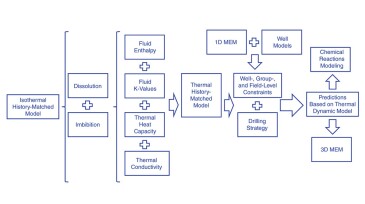
This paper provides guidelines for thermal modeling for carbon capture and storage projects in a depleted gas field.
-
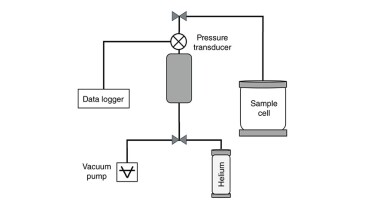
This paper introduces new methods to perform reliable permeability and saturation-dependent relative permeability measurements in organic-rich mudrock core samples using a pressure-decay setup.
-
The authors of this paper present a workflow designed to achieve maximum integration between analytical and modeling activities in carbon capture and storage projects.
-
The authors of this paper present an adaptive grid-coarsening approach based on constraints that honor reservoir structure and stratigraphy, preserve fluid volumes and contacts, and retain resolution near wells.
-
This paper investigates condensate-banking effects on well performance by conducting field-modeling studies on Delaware Basin deep Wolfcamp condensate producers using compositional simulation models with hydraulic fractures.
-
As US shale potentially stares at a production plateau, operators and service providers are turning to smarter tools to extend the life of aging plays.
-
The SPE Reservoir Technical Discipline and Advisory Committee invite their Reservoir members worldwide to participate in a new survey aimed at assessing the current state of reservoir engineering across industry and academia. Deadline is 21 July 2025.