Reservoir

This work describes a study in which distributed data parallel training, paired with a node-local caching pipeline, enabled efficient multigraphics-processing-unit scaling for a CO₂-storage graph-neural-network surrogate while maintaining generalization.

This paper presents a study that confirms glass-reinforced-epoxy-lined tubing as a reliable, cost-effective solution for long-term water-injection service in moderate-salinity offshore environments.

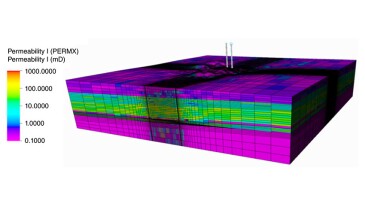
This paper presents a novel reservoir engineering/reservoir simulation approach—a data-driven interwell-connectivity model augmented as a digital twin—to predict reservoir dynamics and optimize operations in the Changqing oil field of China.
-
 The supermajor believes oil and gas will continue to play a major role in the global energy mix over the next 25 years.
 -
The new company, to be called Whitecap, will be the largest Alberta Montney and Duvernay landholder, sporting 370,000 BOE/D in combined production.
-
Few things are more essential to the now global hydraulic fracturing revolution than access to fresh water, yet this dependency use has raised environmental concerns and operational challenges.
-
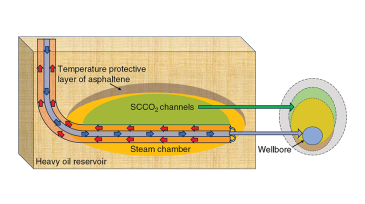
This paper presents a comprehensive model of geothermal exploitation for depleted deep heavy oil reservoirs through supercritical CO₂ injection.
-
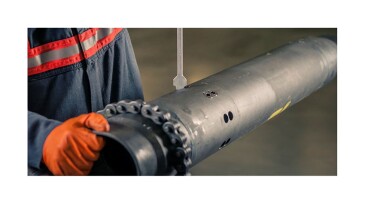
This paper discusses the development of a multientry, multistage fracturing system and its advantages over traditional openhole multistage fracturing solutions.
-
Guest Editorial: 2025 Perspective: Digital Transformation in Oil and Gas—From Evolution to ShockwaveThe path forward is not just about automation—it is about augmentation. AI is not replacing human expertise; it is amplifying it. Those who master this balance will define the future of oil and gas in a rapidly evolving energy landscape.
-
Field examples of operators using chemical restimulation to boost production in aging unconventional wells as an alternative to acid treatments.
-
Transitioning to a low-carbon economy demands large-scale CO2, natural gas, and hydrogen storage. In this context, the application of AI/ML technology to uncover geochemical, microbial, geomechanical, and hydraulic mechanisms related to storage and solve complicated history-matching and optimization problems, thereby enhancing storage efficiency, has been prominently …
-
The authors introduce a novel framework combining dynamic mode decomposition, a data-driven model-reduction technique, with direct data assimilation to streamline the calibration of carbon-dioxide plume evolution models.
-
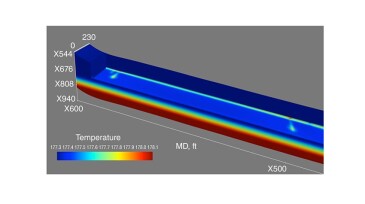
This paper discusses the concept, applications, and continual evolution of a new 3D temperature and spectral-acoustics modeling and logging approach.