Reservoir

The next wave of unconventional growth will likely come from basins in Argentina, the Middle East, Australia, and elsewhere, fueled by expertise gained from shale plays in North America.

Industry experts at URTeC assessed more than a decade of unconventional growth while discussing where productivity gains will come from next.
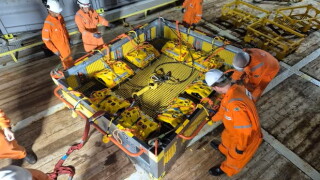
The technology has passed its first phase of qualification, with 84 nodes placed on the seafloor at a depth of 2,000 m to acquire 4D seismic data in the pre-salt Santos Basin.
-
 The multiyear contract with YPF includes electric pumping units and automated stimulation services.
 -
The Orange Basin and Gulf of Guinea will see most of the high-impact drilling activity planned this year in Africa.
-
Technology and partnerships remain important, while phased approaches may supplant lengthy appraisal programs, experts said during CERAWeek.
-
Analysts weigh near‑term risks for Middle East oil and gas producers after a tentative 2‑week ceasefire between the US‑Israeli coalition and Iran.
-
Conflict‑driven price gains may be offset by higher costs, supply‑chain risks, and a limited appetite for new drilling activity.
-
The authors propose a deep-learning-based approach enabling near-real-time CO2-plume visualization and rapid data assimilation incorporating multiple geological realizations for predicting future CO2 plume evolution and area-of-review determination.
-
Steam-assisted gravity drainage (SAGD) technology continues to advance rapidly, driven by improvements in numerical simulation, inflow-control technologies, fiber-optic monitoring, and real-time production optimization.
-
The three featured papers illustrate how emerging computational methods—ranging from gradient-based optimization to data-driven proxies—are reshaping reservoir characterization, uncertainty assessment, and real-time decision support across diverse subsurface applications.
-
In this study, forward simulation is executed by a commercial reservoir simulator while external code is developed for backward calculations.
-
Findings from two new SPE papers argue that the tight-rock sector needs to rethink longstanding assumptions about how hydraulic fractures form underground.