Reservoir

Bridging the gap between foundational guidance and real-world application, SPE’s Oil and Gas Reserves Committee is advancing PRMS education with a new, peer-reviewed training initiative. This article highlights the evolution of the PRMS knowledge base and introduces the PRMS Training Master Slides—a modular, instructor-led framework designed to improve consistency, cl…

Output is rising fast in the South American shale play and putting Argentina on a course to soon reach 1 million B/D.

This case study describes how edge computing and industrial internet of things platforms were deployed to automate and optimize production operations across four distinct basins.
-
 This paper presents design considerations and field-trial applications for determining practical dimensions and limits for interdependencies associated with stage length, perforation clusters, and limited-entry pressures.
 -
The authors of this paper present an approach integrating characterization of paleo zones, parameterization of paleo-zone conductivity, and application of flow profiles in a history-matching study of a dual-porosity/dual-permeability model.
-
The coupled geomechanical and dynamic flow simulation work flow described in this paper relies on a multidisciplinary approach to meet future peak gas demands and support clean-energy initiatives.
-
The technology and knowledge base of the E&P sector is poised to play a major role in the newer, lower-carbon energy economy.
-
In Part 1 of a series of articles, the author highlights candidate selection and problem clarification. This section describes how the success rate of solving conformance problems is improved by reducing assumptions and improving your problem understanding prior to executing a solution.
-
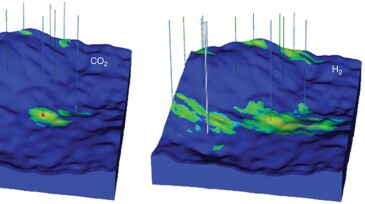
Building up the world’s hydrogen base will need technological breakthroughs and a lot of new demand. But to store it, the world needs reservoir engineers and other subsurface experts.
-
The authors of this paper develop a robust history-matched reservoir simulation model capable of predicting polymerflooding performance in the first such pilot to enhance heavy oil recovery on Alaska’s North Slope.
-
This paper presents autonomous-inflow-control-device installations in multiple horizontal wells of the Singue oilfield development in Ecuador.
-
One of the more common characteristics of heavy oil reservoirs is a low primary recovery factor, which is mainly because of unfavorable mobility ratios between oil and water, negligible solution drives, and faster decline of reservoir pressures because of relatively low oil compressibility. Most of the technologies that apply to heavy oil reservoirs need to address th…
-
The authors of this paper define a work flow that constrains solutions that match models and field observations and obtains a more-representative model for forecasting and optimizing fracture behavior.