Reservoir

The events will be co-located 3–5 May 2027 at Reliant Park in Houston, Texas.

This case study describes how edge computing and industrial internet of things platforms were deployed to automate and optimize production operations across four distinct basins.

Output is rising fast in the South American shale play and putting Argentina on a course to soon reach 1 million B/D.
-
 With only around 30 installations worldwide, ADNOC’s onshore team has seen enough results from its first “fishbone” stimulation to embark on a 10-well program that will decide a full development scheme.
 -
In the complete paper, the authors present a novel approach that uses data-mining techniques on operations data of a complex mature oil field in the Gulf of Suez that is currently being waterflooded.
-
The complete paper aims to identify the role of different geological settings with different types of fluid saturations in the response of EM-wave propagation and absorption.
-
In the complete paper, the authors generate a model by using an artificial-neural-network (ANN) technique to predict both capillary pressure and relative permeability from resistivity.
-
Eni and IBM developed a cognitive engine exploiting a deep-learning approach to scan documents, searching for basin geology concepts and extracting information about petroleum system elements.
-
The complete paper describes the first successful implementation of natural dumpflooding offshore Malaysia as a case study to provide insight into the value of using the approach to maximize oil recovery in a mature field, particularly in a low-margin business climate.
-
The enhanced-oil-recovery literature produced in the past several months was dominated by reservoir modeling and characterization; flood enhancements; machine learning; and, more notably, relative permeability estimation. This last one needs to be understood further.
-
Malaysia’s national oil and company will employ the technology suite in secondary recovery and well stimulation. The deal follows the service provider’s recent agreements in the Middle East.
-
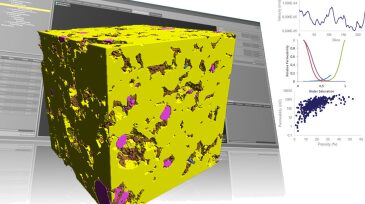
SponsoredThermo Scientific e-Core Software is a unique, high-performance computing platform for the characterization of complex porous media. It focuses on the three essential components of Digital Rock Analysis: parallel computing, multiscale modeling, and process-based reconstruction of 3D volumes.
-
The complete paper outlines some of the challenges involved in late-life field management and how Reserves assessment may be affected.