Reservoir

This study demonstrates how routinely acquired downhole temperature data allows for direct estimation of fluid saturations and delivers more accurate reservoir volume assessments, particularly in aquifer-supported systems.

Sponsored
Effective data analysis depends on seeing connections that matter. Explore how Spotfire enables a more intuitive approach to understanding petroleum data.

The deal adds over 1,000 potential drilling locations and almost doubles oil production for Houston-based Magnolia.
-
 One unfortunate consequence of a base-case model, however, is the risk of an anchoring effect, in which case we may underestimate uncertainty. Essentially, the anchoring effect refers to our tendency to rely too heavily on the information offered, introducing a bias in the model-construction process
 -
Big-data mining techniques can help determe the type-curves and the resulting estimated ultimate recovery of an asset being evaluated for acquisition.
-
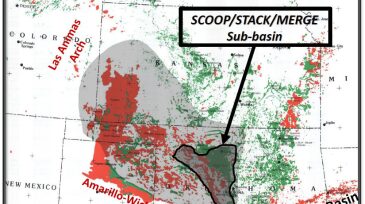
Producers in Oklahoma’s newly opened Merge play are sitting atop a resource that rivals some major world gas fields and discoveries, Citizen Energy’s Geology CEO Greg Augsburger told the SPE Gulf Coast Section Business Development Group recently.
-
Indy Chakrabarti, senior vice president of product management and strategy at Emerson Automation Solutions talks about developments in software solutions for the oil and gas industry.
-
Good diagnostic testing is often painstaking, time-consuming, and costly, but recent studies suggest that a lack of knowledge can be even costlier.
-
In the onshore world, one of the big advances for addressing increased sampling requirements has been to go to 24-hour shooting with continuous recording of simultaneously sweeping vibrators. This has been enabled by innovations in both acquisition and processing.
-
The feasibility test conducted offshore Abu Dhabi demonstrated the successful and safe deployment, seismic-data acquisition, and retrieval capabilities of the AMV and 3D sensor array.
-
The appreciation of empirical realities permits the improvement of commercial depletion planning and enables a greater number of projects. This paper reviews the evidence for and against three doctrines in current use to develop depletion plans.
-
Integrated surveillance is critical for understanding reservoir dynamics and improving field management. A key component of the surveillance is areal monitoring of subsurface changes by use of time-lapse geophysical surveys such as 4D seismic.
-
The complete paper proposes an azimuthal plane-wave-destruction (AzPWD) seismic-diffraction-imaging work flow to efficiently emphasize small-scale features associated with subsurface discontinuities such as faults, channel edges, and fracture swarms.