Reservoir

Canada’s development of large-scale digital drilling core libraries and open geoscience data platforms follows approaches pioneered in Australia, particularly Western Australia, through decades of government investment in geoscience data collection and preservation.

This study explores the carbon-capture and mineralization potential of ultramafic rock powders when exposed to flue gases generated from combustion of crude oil and mesquite-derived charcoal.

This paper documents the testing, integration, and field deployment of a metal expandable packer used as an openhole toe isolation plug in a deepwater well under high-pressure, high-temperature conditions.
-
 Factors such as hydraulic gradients in the horizontal completion, geologic and fluid variations in the reservoir, and well-placement issues can produce very poor steam conformance in steam-assisted gravity drainage (SAGD).
 -
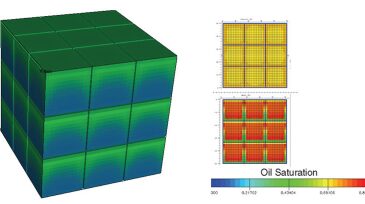
Naturally fractured reservoirs (NFRs) contain a significant amount of remaining petroleum reserves and are now being considered for water-alternating-gas (WAG) flooding as secondary or tertiary recovery.
-
Members of SPE continue to share valuable and useful information through the more than 90 papers on reserves and asset management presented at various meetings, symposiums, and workshops this past year.
-
The Guidelines for Application of the Petroleum Resources Management System (AG) document was issued in November 2011.
-
Reserves- and resources-evaluation methods in unconventional reservoirs are different from those for conventional reservoirs.
-
A carbonate field developed by Petroleum Development Oman is one of the largest fields in the Sultanate of Oman and has been running for more than 4 decades.
-
An integrated-asset-model (IAM) approach has been implemented for the Alpine field and eight associated satellite fields on the western Alaskan North Slope (WNS) to maximize asset value and recovery.
-
A variety of low-cost technologies can result in an increase in production in mature oil and gas fields, although the increase is usually temporary and not always economical.
-
Three observations have resulted from horizontal-well development in the Sulige tight gas field.
-
The North American shale-gas boom has highlighted the differences that a few years and a few thousand miles can make.