Reservoir

Three papers are highlighted as the primary contributions because of their broad industry relevance. They focus on improving formation particle-size characterization, expanding the application of openhole gravel packs in depleted and compartmentalized reservoirs, and advancing the understanding of capillary pressure in sand production.

This paper aims to establish a set of best practices for generating particle-size-distribution data from core samples.

This paper discusses the successful execution of two openhole gravel-pack completions in two Gulf of Mexico fields with depleted reservoirs.
-
 The authors of this paper introduce a physics-based method for explicit pore-pressure prediction in naturally fractured shale petroleum reservoirs.
 -
The authors of this paper aim to identify the effect of various geologic controls on hydrocarbon maturation in the Delaware Basin by restoring regional cross sections and performing simulations of organic-matter maturity.
-
This work applies an appropriate transient-test theory to demonstrate the applicability of each diagnostic plot along with clearly defining the characteristic features that allow each plot to be considered “diagnostic.”
-
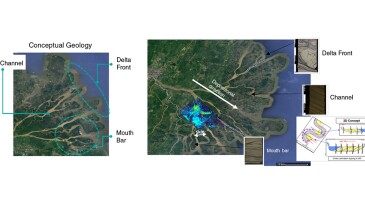
In the life cycle of a field, from exploration and production to development, as we hone our knowledge to understand the reservoir, we often explore various subdomains of formation evaluation at various scales. In this issue, we explore three such subdomains at three different scales.
-
The authors of this paper describe an approach that combined active and passive near-field hydrophone measurements in a complex near-surface area offshore Abu Dhabi.
-
The goal of this paper is to improve the understanding of uncertainties affecting well performance and reservoir connectivity in an offshore Malaysian field.
-
The biggest sand haul ever reported by service provider Enercorp is a reminder that proppant flowback is a mounting challenge for shale producers.
-
The acquisition of Advance Energy Partners shows that private equity groups are successfully maintaining premium valuations for core assets.
-
M&A market activity in the fourth quarter fell from the third-quarter high to $13 billion.
-
The opening ceremony highlighted maximizing production sustainably to meet global demand, integration of simulation and optimization in a single platform with automation, and energy security.