Reservoir

Three papers are highlighted as the primary contributions because of their broad industry relevance. They focus on improving formation particle-size characterization, expanding the application of openhole gravel packs in depleted and compartmentalized reservoirs, and advancing the understanding of capillary pressure in sand production.

This paper aims to establish a set of best practices for generating particle-size-distribution data from core samples.

This paper discusses the successful execution of two openhole gravel-pack completions in two Gulf of Mexico fields with depleted reservoirs.
-
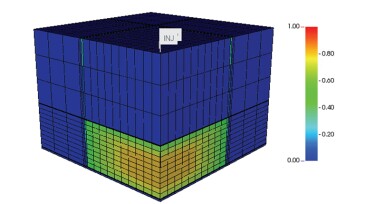
 A critical challenge for those designing carbon dioxide storage sites is predicting where the injected gas will go. One of the only sure bets is to assume that any model of a gas plume that looks symmetrical is likely wrong.
 -
The SPE Hydraulic Fracturing Technology Conference and Exhibition is being held 31 January–2 February in The Woodlands, Texas.
-
This work explores the synergistic effects of smartwater in polymerflooding, surfactant/polymerflooding, carbonated waterflooding, and foam-assisted gas-injection.
-
Our industry has consistently demonstrated resilience, adaptivity, and creativity. In the era of industry transition to low-carbon operations, opportunities exist for selective EOR methods to revive and contribute. The selected papers in this feature include examples of innovative approaches for developing efficient EOR schemes and advanced modeling and optimization.
-
The authors of this paper describe a three-way coupled modeling approach that integrates dynamic, geochemistry, and geomechanics models to obtain cumulative effects of all three changes to evaluate future carbon dioxide storage.
-
In this study, surfactants that can alter wettability or develop ultralow interfacial tension were identified through laboratory measurements for a target carbonate reservoir.
-
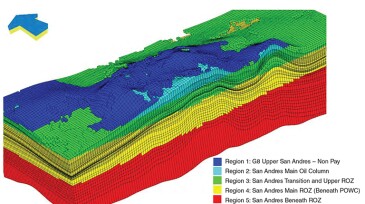
The authors of this paper present an application of a Bayesian framework for uncertainty assessment and efficient history matching of a Permian CO2 enhanced oil recovery field for reliable production forecast.
-
Industry leaders are harnessing the power of data to improve efficiencies, eliminate nonproductive time, and reduce Capex.
-
Before 2012, water management for unconventional oil and gas plays was in its infancy and was trying to keep up with operations. Today, many of the initial challenges have been resolved but new challenges persist. What does the future hold for water in the US onshore unconventional plays?
-
This paper presents results from evaluating the rate of thermal energy that can be extracted under various completion scenarios in end-of-life oil and gas wells using a transient flow simulator.