Offshore/subsea systems

This paper describes the use of encapsulated polymer technology to address the issues of shear degradation and injectivity integrity faced in the application of polymer flooding in an offshore development context.

New technical papers suggest advanced robotic systems may not be far away from broad adoption for a large share of offshore inspection and intervention.

This paper describes the successful deployment of flexible coiled tubing technology in an oil-producing well of the offshore Frade field in Brazil’s Campos Basin.
-
 Douglas-Westwood (DW) expects the expenditure of subsea vessel operations to begin a gentle upswing after next year.
 -
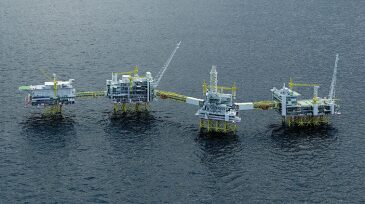
Statoil is going to work to put its enormous Johan Sverdrup discovery into production, showing that even one of the most explored parts of the North Sea still has significant potential.
-
As subsea electric lines age, they are prone to cracks that allow seawater in, reducing their effectiveness, and if the leaks are bad enough, they can shut down operations.
-
To support subsea processing of heavy crudes, an inline electrocoalescer was tested for separation of water droplets dispersed in the crude oil.
-
Projects are being delayed or deferred due to low oil prices, which is affecting the market for subsea, umbilicals, risers, and flowlines (SURF).
-
In this paper, an analysis of the selection of integrated template structures (ITSs) for Arctic environments is presented.
-
This paper describes the architecture of the Lucius Gulf of Mexico subsea production system and the drivers behind it.
-
This paper addresses the standardized features applied to the 10,000-psi-rated subsea-system components at the Espirito Santos FPSO in the Campos basin offshore Brazil.
-
The need for standardization of subsea equipment has never been greater. With the drop in oil prices, cost reduction has become critical.
-
This paper posits a design method for subsea equipment governed by American Petroleum Institute (API) Specification (spec.) 17 (and particularly 17D).