Unconventional/complex reservoirs

Disposal wells remain the lowest-cost solution for produced water, but concerns over seismicity and long-term sustainability are accelerating interest in alternatives.

This work applies fuzzy logic, a well-established artificial-intelligence technique, to quantitatively assess connectivity between injectors and producers in a giant presalt field in the Santos Basin of Brazil.

With a strong presence across US shale in the Bakken, Anadarko Basin, Powder River Basin, and the Permian, Continental Resources is expanding into Argentina’s Vaca Muerta shale as the privately held E&P giant pursues international growth.
-
 In its 2024 outlook, Enverus expects 3-mile-long lateral sections to become a new normal in the Permian and suggests the budding geothermal and lithium arenas may be the real deal.
 -
Two of the most established US independents are combining to form a natural gas powerhouse that will be given a new name later this year.
-
Startup company LongPath Technologies has received conditional federal financing to install 1,000 methane detection towers spanning multiple US states.
-
Houston-based independents will combine to form a company with a production total above 500,000 BOE/D and valued at $21 billion.
-
The “Western Haynesville” boasts big gas IPs with potential running room.
-
This study presents a novel approach to screen thermally stable surfactants at high pressures and high temperatures for the explicit purpose of wettability alteration in the operator’s Eagle Ford acreage.
-
Highlights of innovations in fracturing, drilling, and reservoir engineering include mysterious gummy bears, horseshoe-shaped wells, and automated rigs.
-
An engineered approach to fracture growth in hydraulic fracturing highlights the successful execution of H2S prevention strategies in North Dakota’s Williston Basin.
-
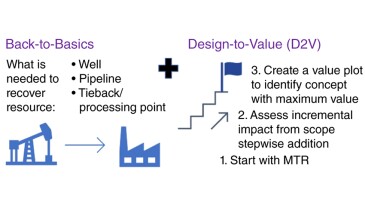
This paper describes a revamped methodology for field-development strategy formulation, particularly for marginal hydrocarbon resources, by shifting the mindset toward designing with an aim to value in order to improve project viability.
-
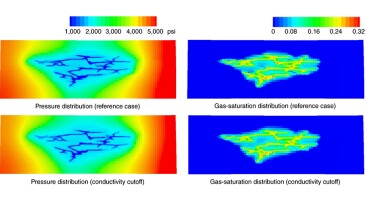
The authors of this paper present an advanced dual-porosity, dual-permeability (A-DPDK) work flow that leverages benefits of discrete fracture and DPDK modeling approaches.