Testing page for app
-
 Understanding well and reservoir performance is the ultimate goal of data gathering.
-
The growth in unconventionals production and the spotlight on hydraulic fracturing have heightened public concern about oil and gas industry operations and raised the stakes for those working in the industry.
-
In some operating areas, the change in ambient temperature from day to night can exceed 50°F. This cyclic temperature change can cause false pressure responses in low-quality pressure gauges and significant pressure responses in the wellbore.
-
This paper presents a new approach in monitoring the hydraulic system and in the recognition of well‑control events at an early stage such that proper counteractions can be initiated before any damage occurs.
-
This paper reports results of a well-control study for a program to develop a dual-gradient-drilling (DGD) system known as controlled mud pressure (CMP).
-
The development of the Kanowit field offshore Sarawak, Malaysia, requires the drilling of two subsea development wells with a semisubmersible rig.
-
Ferrous sulfide (FeS) precipitation increases during shale-gas and -oil production because of increased biologically and thermally induced sulfide production. Although FeS scale is abundant, little is understood about its precipitation and inhibition properties.
-
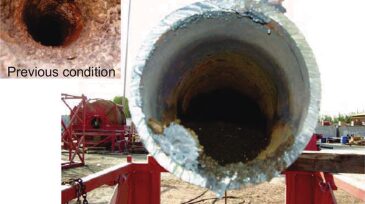
The gas-producing carbonate zones of the Ghawar field in eastern Saudi Arabia have been affected by extensive iron sulfide (FeS) scale deposition, reducing overall gas production and increasing risks during well interventions.
-
This paper describes various sulfide inhibitor-testing techniques that have been applied to candidate products for the management of zinc sulfide (ZnS) and lead sulfide (PbS) in a gas/condensate field with a known relatively severe ZnS/PbS scaling problem.
-
Critical to success is the accurate testing in the laboratory that best approximates field conditions.