Testing page for app
-
 In the complete paper, the authors revisit fundamental concepts of reservoir simulation in unconventional reservoirs and summarize several examples that form part of an archive of lessons learned.
 -
In the complete paper, a novel hybrid approach is presented in which a physics-based nonlocal modeling framework is coupled with data-driven clustering techniques to provide a fast and accurate multiscale modeling of compartmentalized reservoirs.
-
In the complete paper, the authors reduce nonuniqueness and ensure physically feasible results in multiwell deconvolution by incorporating constraints and knowledge to methodology already established in the literature.
-
The complete paper highlights examples of nonmetallic materials selection and qualification for upstream water-injection and producer and hydrocarbon wells and presents suggestions for future progress.
-
The complete paper presents the results of evaluation of laboratory and demonstration trials of HDPE liner to mitigate premature failures and prolong the run life of production tubing.
-
The complete paper describes an operator’s experience in confirming glass fiber-reinforced epoxy (GRE) as an effective alternative to high-grade corrosion-resistant alloys (CRA) to extend tubing life in high-velocity gas wells.
-
The complete paper presents a large-scale work flow designed to take a vast amount of data into consideration. The work flow can be scaled for projects of any size, depending on the data available.
-
An opportunity now exists to further develop the way we solve problems by adopting agile work flows. Originating from software development in 2001, agile work flows will be a key part of driving the oil and gas industry to its next level of efficiency.
-
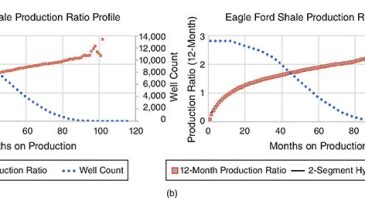
The complete paper discusses the use of cumulative production ratio curves normalized to a given reference volume in time for different unconventional plays in North America to investigate the median trend for each play and the median ultimate recovery per play.
-
In tectonically influenced regions, potential hydrocarbon traps are subject to complex states of stress. This scenario often translates into severe strike/slip (SS) and thrust-fault or reverse-fault (TF/RF) stress states.