

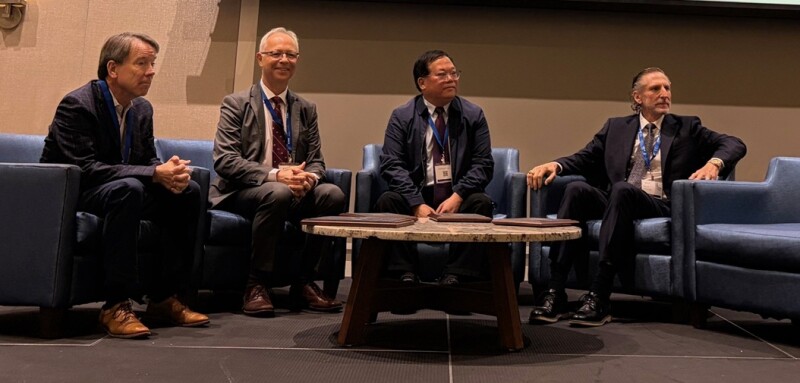
The SPE Mid-Continent Section has newly recognized three pioneers of improved oil recovery, presenting them with the IOR 2026 Pioneer Awards at the 2026 SPE Improved Oil Recovery Conference in Tulsa.
“These pioneers are largely responsible for the state of improved oil recovery that we have today,” said Randy Seright, chair of the awards committee and award recipient in 2008. “The IOR Pioneer Award is basically a lifetime achievement award and is the most prestigious award given in the area of improved oil recovery.”
The SPE IOR Conference has been held every two years since 1978, and the Pioneer Awards have been presented since 1984.
Three pioneers received the award at the conference this year— Birol Dindoruk , Liao Guangzhi, and David Schechter.
Birol Dindoruk, Texas A&M University

Dindoruk is an endowed professor in the Petroleum Engineering Department at Texas A&M University and a consulting professor at Stanford University. Previously, he was at the University of Houston. Before entering academia, Dindoruk was a chief scientist of reservoir physics at Shell.
While at Shell Technology Applications and Rersearch, Dindoruk was responsible for the development and deployment of new IOR technologies across the company’s portfolio. He led the development of novel gas injection and solvent-based recovery processes and drove the advancement of field-scale simulation models that incorporated realistic compositional effects, enabling better prediction of IOR project outcomes.
Lynn Orr, former Under Secretary for Science and Energy of the US Department of Energy and professor of engineering at Stanford University, has said that Dindoruk’s work at Stanford led to a “quantum leap” in the understanding of multicomponent gas injection processes.
“He joined my research group in the late 1980s, and the work he did then led to a quantum leap in our understanding of how multicomponent gas injection processes for enhanced oil recovery actually work," Orr said. "His work led to subsequent work by a dozen students and postdocs.”
Dindoruk was also recognized for his efforts in integrating CO2 sequestration with enhanced recovery, paving the way for CO2-EOR as a pathway for both recovery and decarbonization and leading to his induction into the National Academy of Engineering in 2017.
"Receiving this award is truly an honor,” Dindoruk said. “It has been a considerable milestone in my career, and I am thankful for the collaborators that support this journey.”
“IOR has always been about innovation and optimization,” Dindoruk said. “As energy challenges evolve, these technologies will continue to be important for improving recovery, reducing waste, and supporting lower-carbon development strategies.”
Looking to the future, Dindoruk said the subsurface will remain important.
“I think subsurface/reservoirs are here to stay,” he said. “Whether they are used for hydrocarbon production or storage of some type, they will have multiple uses. Some we may think of today, but there might be other opportunities later. For example, just geothermal energy. It used to have limited applications for certain sweet spots; now, we are looking at it in a broader sense.”
Dindoruk added, “What is impossible to foresee today will be easy to see tomorrow. Therefore, basic skills and broader vision of what we can use our skills for in combination with the fundamentals will prepare us for a more intertwined and interdisciplinary future. We should look at our skills in a broader way.”
While presenting the award, Seright highlighted the enduring effect of Dindoruk’s work.
“The property calculators, correlations, and models he developed are still in use by hundreds of practicing engineers, underscoring the lasting impact of his industrial leadership,” Seright said.
David Schechter, Louisiana State University

Schechter is the department chair and a distinguished professor in the Department of Petroleum Engineering at Louisiana State University. He is also vice president and on the board of directors of technology company EOR ETC and chief technology officer for enhanced oil recovery (EOR) company Third Wave Production. Both companies work on huff ’n’ puff surfactant EOR projects in tight reservoirs—the Eagle Ford, Wolfcamp, and Bakken reservoirs and the DJ Basin.
Seright said that Schechter’s “standout” contribution to IOR was that “he has been at the very forefront of developing and applying EOR processes in tight reservoirs for the past 35 years.”
Seright added, “Dr. Schechter has also had a major impact on analysis and development of naturally fractured reservoirs for the past 35 years. Some of the very best work on surfactant imbibition into shales for the past 10 years has been by David and members of his research group.”
Liao Guangzhi, CNPC/PetroChina

Guangzhi is a senior expert and chief engineer at the China National Petroleum Corporation (CNPC)/PetroChina.
Guangzhi was recognized as a pioneer in IOR for his work in the development of extra-heavy-oil steamflooding in the Xinjiang Karamay oil field, which led to the recovery of 4 million tons of incremental production.
He was also credited with pioneering the development of oxygen-reduced air flooding and high-temperature in-situ combustion, advancing methods to control oxygen concentration in injected air precisely to ensure stable and safe combustion while improving reservoir adaptability.
Guangzhi’s achievements extend to establishing theoretical models for oxidation kinetics and combustion front stability. He also directed large-scale field pilots in the Liaohe, Xinjiang, and Dagang oil fields to demonstrate the feasibility of applying these technologies in heavy oil and mature reservoirs.
“Dr. Liao is a visionary leader who has guided PetroChina in building the world’s largest industrial IOR program, especially in chemical flooding,” Seright said. “Over his 30-year career, he organized and supervised more than 100 major pilot projects across PetroChina oil fields, covering polymer flooding, ASP [alkaline/surfactant/polymer] flooding, foam flooding, binary flooding, SAGD [steam-assisted gravity drainage], CO2 injection, and air flooding.”