Acidizing/stimulation

The Acid Stimulation Technical Section aims to provide a global home for engineers, scientists, researchers, and practitioners working on acid stimulation in carbonate and sandstone reservoirs.

This paper presents a case study of a tool-free fishbone fracture stimulation technology using sand jetting and acidizing in openhole wells, providing a technical solution for low-permeability and complex-lithology carbonate reservoirs in the Middle East.

This paper presents a case study of oriented tubing-conveyed perforation followed by an acidizing operation to overcome technical challenges posed by a depleted reservoir targeted for a carbon capture, utilization, and storage project.
-
 This paper presents a novel mathematical model for design and evaluation of fluoroboric acid treatments that takes into account the chemical kinetics and equilibrium aspects of important reactions and fluid flow inside the reservoir rock.
 -
This paper presents design considerations and field-trial applications for determining practical dimensions and limits for interdependencies associated with stage length, perforation clusters, and limited-entry pressures.
-
This paper focuses on identifying a hydrofluoric-acid-derivative treatment that could be used as a single-step sandstone-acid treatment with all the associated benefits but without the need for acid-flowback services.
-
To improve the productivity index of a well in a carbonate reservoir offshore Abu Dhabi, a multilateral acid-jetting technology was adopted as a more-effective alternative to typical drainage methods.
-
It is pleasantly surprising to find a revival in sandstone acidizing. For many years, sandstone acidizing was becoming almost a lost art, overshadowed by carbonate acidizing and hydraulic fracturing.
-
The authors describe a self-breaking, formation-damage-free, novel nanoparticle-based gelled-acid system to replace polymer-based gelled-acid systems.
-
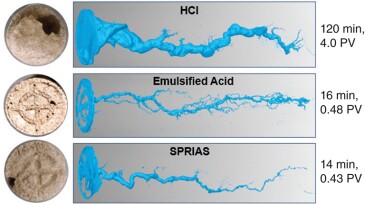
The authors describe the benefits of a single-phase retarded inorganic acid system, which they write features the same benefits as emulsified acids while eliminating the drawbacks of the latter.
-
This paper presents a novel sandstone-stimulation technique using thermochemical fluids.
-
Carbonate reservoirs require effective acid stimulation to improve well productivity. For long horizontal wells, a complicating factor has previously been the difficulty of controlling acid placement along the reservoir section. The Smart Liner concept uses a number of small holes spaced in such a way so as to distribute the acid evenly along the reservoir interval.
-
HCl acid stimulation of carbonate production requires the retardation of the HCl-carbonate rock reaction to achieve the optimum balance between total fluid used and the enhancement of well production. The described investigation was done offshore Sarawak using Indiana Limestone cores.