Completions

This paper aims to establish a set of best practices for generating particle-size-distribution data from core samples.

This paper discusses the successful execution of two openhole gravel-pack completions in two Gulf of Mexico fields with depleted reservoirs.

By integrating experimental and mathematical modeling approaches, this work aims to advance the understanding of sand-detachment dynamics and formation instability under varying saturation conditions.
-
 This paper presents an evaluation of geopolymer cementing for use in oil and gas wells, specifically in the primary cementing of liner strings in the Permian Basin.
 -
Matthew Bryant has spent years trying to convince engineers that the API proppant testing standard has significant limitations. And he may well be right.
-
Operators are turning the tide on the Lower Tertiary trend with increasingly large stimulations that are also pushing the limits of offshore technology.
-
The Midland-based service company operates a fleet that is now 65% either dual-fuel or electric-powered.
-
The second major deal in the US proppant industry this year will see US Silica go forward as a private company.
-
This paper explains how an operator’s projects in the Vaca Muerta have become more-efficient and cost-effective by increasing production and reducing well-delivery-cycle time while fostering the long-term sustainability of the project.
-
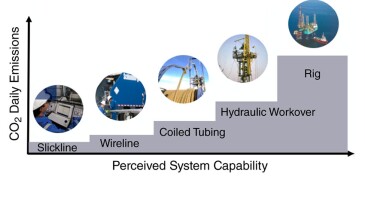
The authors challenge the traditional planning and execution of interventions, both from an operational and commercial standpoint, and examine where room exists for significant improvement in the industry
-
Despite tens of thousands of potential candidates and the proven upsides, the unconventional industry has largely overlooked refracturing—possibly due to the way it’s discussed.
-
To avoid costly interventions like sidetracking or wellbore abandonment, a check-valve system was installed near the sandface within three injector wells which prevented the mobilization of fines from the reservoir into the wellbore by stopping backflow.
-
Corrosion Inhibition of Benzyl Quinoline Chloride Derivative-Based Formulation for Acidizing ProcessDevelopment and implementation of a more effective and environmentally friendly acidizing corrosion inhibitor derived from benzyl quinoline chloride to mitigate rapid corrosion of metal-based drilling equipment.