Completions

Industry experts at URTeC assessed more than a decade of unconventional growth while discussing where productivity gains will come from next.

Chevron and Halliburton describe how they built and deployed the fully autonomous closed-loop fracturing system that enables subsurface-driven optimization.

Weatherford CEO Girish K. Saligram said the acquisition will bolster Weatherford’s completions offerings and unconventional reservoir capabilities.
-
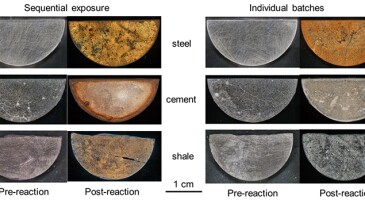
 The authors of this paper demonstrate that future produced-water management and scale-mineral control may need to consider the sequential exposure effect of steel, cement, and shale on fluid chemistry and mineral precipitation.
 -
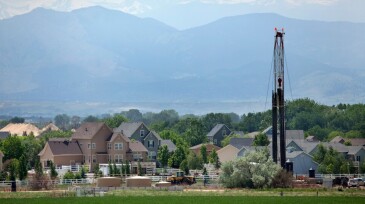
Pennsylvania children living near unconventional oil and gas developments at birth were two to three times more likely to be diagnosed with leukemia between the ages of 2 and 7 than those who did not live near this oil and gas activity, after accounting for other factors that could influence cancer risk, a novel study from the Yale School of Public Health finds.
-
Devon, Shell, and SM Energy offer some of their latest learnings from recent independent subsurface diagnostics projects. Their work underscores why this arena of technology has become a cornerstone for hydraulic-fracture design in tight-rock reservoirs.
-
This paper highlights solids-management technologies that are currently available and still in use topside (some of which are potentially outdated).
-
This paper describes a new intelligent dosing technology to reduce liquid loading in an unconventional tight gas reservoir.
-
The key element of hydraulic-fracture modeling is the prediction of the generated fracture geometries. Research conducted over the years has trickled down predictive software. Nevertheless, the ability to design optimal fracture treatments is hampered, as we cannot “see” the subsurface.
-
Second-quarter earnings for the three biggest oilfield service companies arrived with some new takes on where the market is headed.
-
HiberHilo will be used to monitor remote oil and gas wells in Papua New Guinea, providing real-time performance and safety data.
-
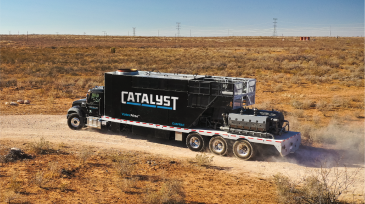
SponsoredCatalyst Energy Services’ innovative technology lowers CO2 equivalent greenhouse gas emissions up to 40% and reduces waste up to 99% without sacrificing production output.
-
The paper presents a time-domain electromagnetic tool capable of quantifying four barriers individually and inspecting a fifth barrier qualitatively.