Completions

This paper presents a study that confirms glass-reinforced-epoxy-lined tubing as a reliable, cost-effective solution for long-term water-injection service in moderate-salinity offshore environments.

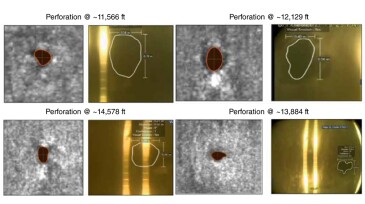
This paper introduces in-pipe inspection technologies enabling high-resolution digital measurements of tubular internal diameter and wall thickness for critical downhole applications.
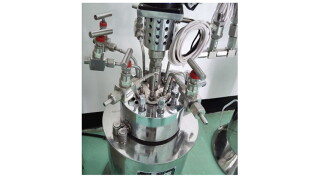
This study aims to systematically assess casing integrity and corrosion risks associated with CO2 injection in oil-recovery operations.
-
 This paper presents an intelligent tube solution that combines data retrieved by the sensors with the actual resistance of each pipe in the well to allow adjustment of production parameters while ensuring installation safety.
 -
This paper introduces a method using a Bayesian network to aggregate trends detected in time-series data with events identified by natural language processing to improve the accuracy and robustness of kick and lost-circulation detection.
-
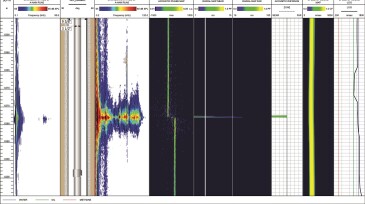
Diagnostics firm TGT launched its newest acoustic platform that it says broadens flow analysis by adding radial distance to the data collected.
-
The US-based drilling contractor and well completions company will combine to form the second-biggest service company in North America.
-
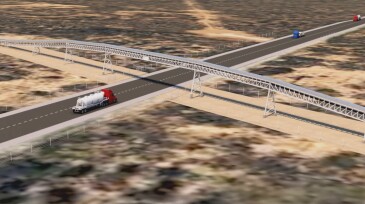
The first long-haul overland conveyor system to deliver proppant is under construction in the Permian Basin.
-
Coiled tubing has a key role to play, with strong arguments for itself: It is used throughout the life of a well, from exploration to abandonment, and its flexibility of use, combined with recent technology developments in pipe materials, real-time downhole telemetry, and specialized downhole tools—just to name a few—opens avenues to perform in a rigless manner many o…
-
The first acid job dates to 1895. Challenges remain, however, when it comes to lithology, coverage, penetration, and management of reaction products. These themes remain a focus for stimulation engineers.
-
When there are two ways to measure something, and they offer significantly different numbers, which do you use?
-
Fracture monitoring to optimize fluid volumes and designs remains a critical area of development. Research is ongoing with the focus on combining different monitoring technologies including tracers, fiber optics, downhole cameras, and microseismic monitoring.
-
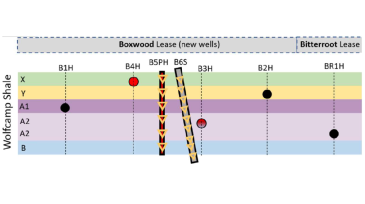
This paper describes efforts at the Hydraulic Fracturing Test Site 2 to collect a research data set to improve understating of spatial and temporal hydraulic fracture dimensions, proppant distribution, and reservoir depletion.