Data & Analytics

Switching from continuous circulation to cyclic huff-‘n’-puff operation in enhanced geothermal systems can significantly delay thermal breakthrough, sustain higher production temperatures, and improve long-term economic performance.

The two companies say they plan to work together to use agentic AI to increase the capabilities of technical experts.

This article is the first in a Q&A series from the SPE Methane Emissions Management Technical Section (MEMTS) on methane intelligence and how oil and gas teams translate emissions data into credible decisions and measurable reductions.
-
 This paper describes an artificial intelligence deep Q network for field-development plan optimization.
 -
In this paper, the authors describe a model that uses augmented artificial intelligence to optimize well spacing by use of data sculpting, domain and feature engineering, and machine learning.
-
The UK’s Oil and Gas Authority has released 50 years of data from the North Sea in an effort to boost exploration and production and locate potential sites for carbon storage.
-
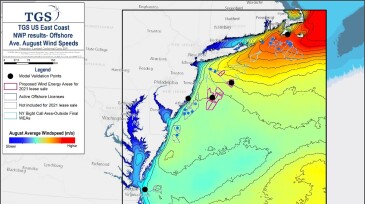
The larger data set is expected to provide critical insight for wind resource assessment in the New York Bight lease sale.
-
True digital transformation is the way forward, and companies that actively embrace and manage digital transformation will make their businesses smarter, more efficient, and vastly more profitable.
-
The 2021 Geothermal Experience Datathon focused on the application of analytics and data-science tools on oil and gas well-log data to assess geothermal potential in two North American basins.
-
Fiber-optic technology company Silixa announced the installation, validation, and borehole seismic acquisition from a permanently installed fiber-optic distributed acoustic sensing system on BP’s Atlantis Phase 3 subsea field development.
-
The US Department of Energy’s Office of Fossil Energy and Carbon Management awarded a total of $600,000 to four software developers who won a contest to support FECM’s Science-Informed Machine Learning to Accelerate Real-Time Decisions in the Subsurface Initiative.
-
SponsoredRod lift failure frequency in horizontal wells drives significant operating expenses. Understanding why these failures occur leads to a solution — production optimization with automated setpoint changes, which can extend the life of this equipment and reduce downtime.
-
Most people would agree that society’s first challenge is to shift the world toward a new energy paradigm based on technologies that do not contribute to climate change. But the cold evidence leaves little doubt that this transition is taking longer than we hoped. Consequently, the other challenge is that we need to actively reduce the emissions of the legacy assets t…