Data & Analytics

Working with Dell Technologies and NVIDIA, the French supermajor is targeting improved seismic processing and artificial intelligence applications.

A discussion at the inaugural executive breakfast convened by the SPE Data Science and Engineering Analytics Technical Section, held alongside CERAWeek by S&P Global and powered by Black & Veatch, tackled the challenge of value creation from artificial intelligence in the energy industry.

AI‑driven data center growth is straining US power grids and accelerating interest in enhanced geothermal systems as a scalable, low‑carbon solution.
-
 Scientists at the Sandia National Laboratories are using machine learning to find methane hydrates on the seafloor, using an approach similar to weather forecasting.
 -
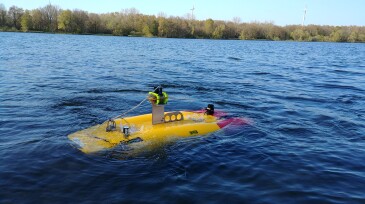
The new DeeperSense project, an international consortium led by the German Research Center for Artificial Intelligence, is working on technologies that combine the strengths of visual and acoustic sensors with the help of artificial intelligence. The aim is to significantly improve the perception of robotic underwater vehicles.
-
The infrastructure engineering software firm is expected to pay more than $1 billion to acquire geological and geophysical modeling software developer Seequent.
-
Honeywell's H1 quantum system has reached a record-high quantum volume.
-
According to a World Economic Forum report, digital transformation in the oil and gas industry could unlock approximately $1.6 trillion of value for the industry, its customers, and wider society while creating around $1 trillion of value for oil and gas firms.
-
Start-and-stop data management initiatives and a mishmash of partial solutions are no longer viable for managing the digital oil field. Data management should be transformed from a cost center to a cash-flow-generating function.
-
Technology is advancing, and applications are growing, but scaling faces technological and human challenges.
-
Algorithms are taking over the world, or so we are led to believe, given their growing pervasiveness in multiple fields of human endeavor such as consumer marketing, finance, design and manufacturing, health care, politics, and sports. The focus of this article is to examine where things stand in regard to the application of these techniques for managing subsurface en…
-
Artificial intelligence is opening new ways to analyze data from microseismic events that occur during hydraulic fracturing. One researcher at Moscow’s Skolkovo Institute of Science and Technology is building a convolutional neural network to get a subsurface view of permeability after fracturing.
-
The cultural perception of AI is often suspect because of the challenges in knowing why a deep neural network makes its predictions. So researchers try to crack open this black box after a network is trained to correlate results with inputs. But what if the goal of explainability could be designed into the network's architecture, before the model is trained and withou…