Drilling

Research by Enervus sees early 2026 permitting activity for the carbon capture and storage wells pointing to a growing approval queue, even while the rate of applications eases.

The new guidelines were released prior to reports that enhanced geothermal developer Fervo Energy experienced a blowout in Utah with no reported injuries.

BP said it expects to keep the Azeri-Chirag-Gunashli (ACG) project in production into the 2040s by tapping into separate nonassociated gas reservoirs.
-
 This paper describes a new approach to evaluating the effectiveness of the rotary-steerable-system (RSS) steering mechanism on wellbore tortuosity in horizontal wells.
 -
With the arrival and development of rotary steerable systems in the late 1990s, the industry thought that drilling a perfectly smooth and controlled trajectory would not be an issue. Two decades later, we’re still talking about wellbore quality, especially with long and complex horizontal wells.
-
The use of organophilic clays as additives to provide proper rheological and filtration properties in nonaqueous drilling fluids (NADFs) has long been a topic of study. This paper introduced a modified rectorite designed for biodiesel-based drilling fluid (BBDF).
-
The reservoir section of a gas field offshore Sarawak, Malaysia, consists of two massive pinnacle carbonate structures with heterogeneous porosity and permeability and many vugs and faults.
-
Organophilic clays mixed in oil-based drilling fluids (OBDFs) do not exhibit the same viscosity or suspension characteristics as they do in water-based drilling fluids. A new mineral-oil-based drilling fluid (MOBDF) was created by replacing the conventional organophilic clay with a novel polymer.
-
It is no secret that drilling fluid is crucial in drilling operations. The main function of drilling fluids is to transport drill cuttings from the bottom of the hole up to the surface. Drill cuttings then will be separated on the surface before being recycled back for further drilling.
-
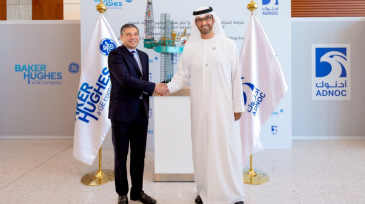
The union marks the first time an international company has taken a direct equity stake in one of ADNOC’s service companies. BHGE will expand its presence in UAE, while ADNOC will gain access to BHGE technological expertise and proprietary equipment.
-
A new detection and alerting methodology, validated on more than 100 North America onshore wells, blends well information and real-time data to determine a probabilistic belief system. An operator used the system to detect, predict, and alert rig crews to washouts and pump failures.
-
Despite a trend toward renewables and low-carbon energy production among European majors, Total remains wholeheartedly committed to deepwater production.
-
Predicting the trajectory of a satellite, or a well, requires sophisticated analysis to reduce the huge uncertainties. That adds to the many things drillers should be thinking about, which can be overwhelming.