Enhanced recovery

Coreflood experiments reveal that alkali significantly reduces viscosity loss in polyacrylamide flooding systems by minimizing adsorption and improving polymer stability under shear stress. The findings position viscosity retention as a key screening criterion for successful alkali-polymer enhanced-oil-recovery applications.

This study investigates the potential for in-situ hydrogen generation from hydrocarbons using in-situ combustion, with particular emphasis on the role of kerogen content and heating mode.

This paper presents the application of degradable particulate-diverter technology to improve oil production by effectively diverting stimulation treatment fluids away from high-water-cut, high-permeability, high-temperature producing intervals or zones.
-
 The objective of this study is to conduct a comprehensive review of the latest technologies and work flows developed for heavy oil reservoir management.
-
The authors of this paper evaluate the effectiveness of production-enhancement activities for a long-string, gas-lifted producer using distributed-temperature-sensing technology.
-
The authors of this paper write that 4D data are an integral part of a reservoir-management program and, together with geological and production history data, are being used to update reservoir models to further the goals of field development.
-
Carbon capture and storage, with the potential for usage, will be crucial if the world is to prevent global warming. While Norway has been injecting captured CO2 in saline aquifers since the mid-1990s, there has been no attempt, and no plans exist, in Europe to use CO2 for EOR. Why not?
-
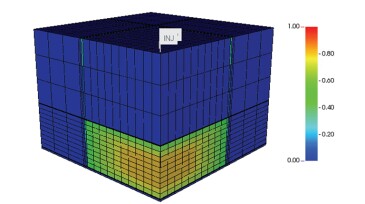
This work explores the synergistic effects of smartwater in polymerflooding, surfactant/polymerflooding, carbonated waterflooding, and foam-assisted gas-injection.
-
Our industry has consistently demonstrated resilience, adaptivity, and creativity. In the era of industry transition to low-carbon operations, opportunities exist for selective EOR methods to revive and contribute. The selected papers in this feature include examples of innovative approaches for developing efficient EOR schemes and advanced modeling and optimization.
-
In this study, surfactants that can alter wettability or develop ultralow interfacial tension were identified through laboratory measurements for a target carbonate reservoir.
-
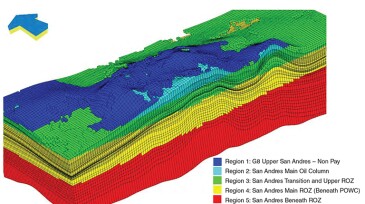
The authors of this paper present an application of a Bayesian framework for uncertainty assessment and efficient history matching of a Permian CO2 enhanced oil recovery field for reliable production forecast.
-
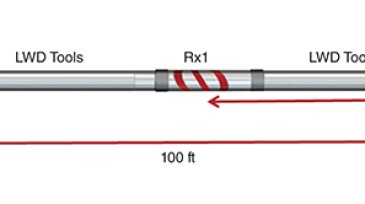
This paper describes the deployment of an ultradeep electromagnetic directional-resistivity instrument to map injection-water movement.
-
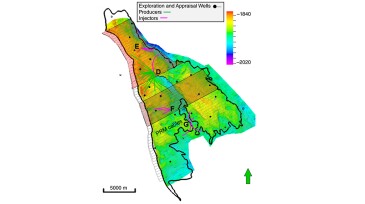
This paper shares details of 2 years of monitoring the first commingled updip smart water injector drilled in the Piltun area of the Piltun-Astokhskoye offshore oil and gas field.