Enhanced recovery

This paper presents a study that confirms glass-reinforced-epoxy-lined tubing as a reliable, cost-effective solution for long-term water-injection service in moderate-salinity offshore environments.

This paper presents a novel reservoir engineering/reservoir simulation approach—a data-driven interwell-connectivity model augmented as a digital twin—to predict reservoir dynamics and optimize operations in the Changqing oil field of China.
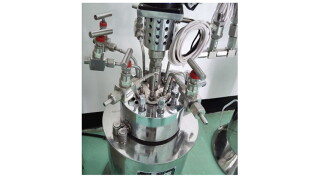
This study aims to systematically assess casing integrity and corrosion risks associated with CO2 injection in oil-recovery operations.
-
 Polymer flooding in sensitive areas can require the transport of polymer fluids over long distances. Conventional wisdom limits transport distance or degradation occurs. This paper argues that critical velocity, not distance, is the controlling factor.
 -
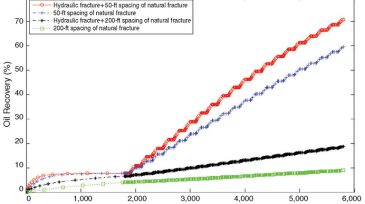
This paper focuses on the effects of injected-gas composition and fracture properties on oil recovery, concluding that cyclic gas injection in hydraulically fractured shale oil reservoirs is feasible for improving oil production substantially over primary production.
-
Initially, polymer flooding had not been considered as a viable enhanced-oil-recover (EOR) technology for Pelican Lake in northern Alberta, Canada, because of the high viscosity of the oil until it was considered in combination with horizontal wells.
-
Surface jet pumps (SJPs) are simple, low-cost, passive devices that use a high-pressure (HP) fluid as the motive force to boost the pressure of produced-gas and -liquid phases.
-
Saudi Aramco’s plan to create a global network of research centers is becoming a reality. It recently celebrated the opening of its Houston center that the company’s President and Chief Executive Officer Khalid Al-Falih described as “an upstream research center like no other.”
-
Polymer flooding has been used to enhance the production of oil from mature fields in Oman. This article discusses the trial of several approaches to improve the treatment of water produced from these fields.
-
A major heavy oil producer in California has agreed to test a device that is designed to reduce emissions of smog-producing gases and increase the efficiency of gas burners.
-
Production of low-viscosity liquids, including condensates, from tight reservoirs such as shales is severely restricted by the ultralow permeability of such formations, limiting production to a very small fraction, usually less than 5%, of the liquids in place.
-
An operator has launched a successful, limited-scope deployment of a nonparametric capability known as event detection and association (EDA).
-
Demand for a better way to remove carbon dioxide (CO2) from natural gas led to the creation of a new material at Rice University in Houston that does something unprecedented on the molecular scale, and might even change gas processing.