Fracturing/pressure pumping

The Seismos full-scale research center opens to industry, universities, and national laboratories, advancing acoustic sensing across upstream energy, pipelines, critical infrastructure, and national security.

This article from the SPE Research and Development Technical Section offers new insights to how the upstream industry can benefit from the emergence of quantum computing.

This contributed article highlights the growing importance of fiber-optic sensing and its potential to advance thanks to emerging quantum technologies.
-
 Shale producers have learned in recent years that their fracture plugs may not be holding up as well as they thought. One of the first operators to realize the true scope of the issue is now sharing the pathway it took to solving it.
 -
The supermajor would be the second to conduct a hydraulic fracturing pilot project in the country.
-
Ease of use and crowd-pleasing economics are driving US shale producers toward wet-sand completions. Chesapeake Energy is among the latest converts and explains why it wants to use wet sand on every new well.
-
Offset well-pressure measurements in the Permian Basin are analyzed to evaluate if a fracturing job is overstimulated.
-
The authors use machine-learning methods combined with geomechanical, wellbore-trajectory, and completion data sets to develop models that predict which stages will experience difficulties during completion.
-
ExxonMobil submitted a proposal to Colombian authorities to develop a hydraulic fracturing pilot project in the Magdalena Basin. Colombia wants to drastically raise its declining reserves-to-production ratio by tapping into shale.
-
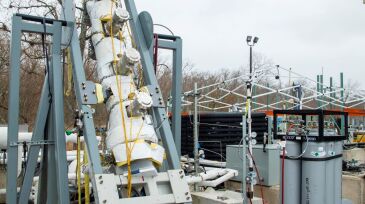
New Testing Facility Built To Prove Whether Natural-Gas Foam Is Shale Sector's Next Fracturing FluidA 6-year R&D project concludes with the completion of a technology kit designed to study how combining highly pressurized natural gas and water could be a holistic alternative to traditional hydraulic fracturing.
-
A pressure-monitoring technique using an offset sealed wellbore as a monitoring source has led to advancements in quantifying cluster efficiencies of hydraulic stimulations in real time.
-
Is it possible to fracture a well using power off the grid? The answer is yes, but sharp electric engineers are required.
-
The two-well stimulation approach is delivering big savings to first adopters. A new report from Rystad highlights how the development is taking shape.