Fracturing/pressure pumping

Industry experts at URTeC assessed more than a decade of unconventional growth while discussing where productivity gains will come from next.

Chevron and Halliburton describe how they built and deployed the fully autonomous closed-loop fracturing system that enables subsurface-driven optimization.

The paper presents the design and successful field deployment of the first closed-loop hydraulic fracturing program.
-
 The evolution of hydraulic fracturing is a long and circuitous one that deserves examination. Engineering and completions leaders from Liberty Oilfield Services did just that, authoring a paper that encapsulates the high points in the development of the groundbreaking completions practice.
 -
This paper presents a newly developed model to predict the breakdown pressures in cased and perforated wells.
-
As gas development focuses more on tight and ultratight formations, the challenges to produce economically become diverse and more intense. One main challenge faced while fracturing a well is a high fracture gradient.
-
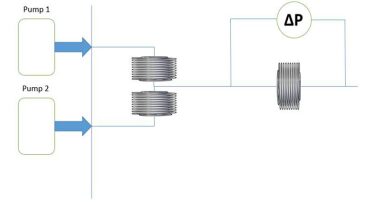
This paper presents a newly designed triaxial fracturing system and describes a series of experiments that verified the validity of tool-free chemical diversion for multistage fracturing of openhole horizontal wells.
-
This paper presents a unique work flow that addresses in real time the challenges of perforation and fracture-treatment design while accounting for the lithologic and stress variability along the wellbore and its surroundings.
-
In this study, a laboratory analysis was conducted to study the effect of a phosphonate-based scale inhibitor on a mixture of hypersaline Arabian Gulf seawater and formation water under high-temperature/high-pressure conditions.
-
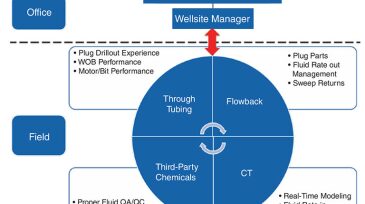
This paper presents a factory-model approach to improving CT drillout performance that has been used successfully for more than 3 years and has become standard practice.
-
This paper contains a detailed discussion of methods and a software tool that has been developed to generate information that predicts formation-face pressures in real time with the help of live bottomhole-pressure data.
-
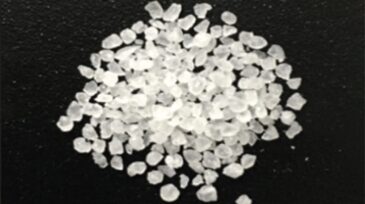
The very first fracturing job used sand scooped from a nearby river. After decades of buying sand based on tight size standards, unconventional operators are increasingly going back to a broad range of sizes, similar to that river sand.
-
In the fast-moving US shale sector, no market trend seems to last long. The pressure pumping market exemplifies the maxim.