Production

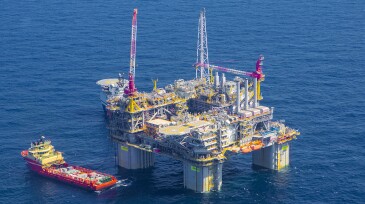
Production has begun at the company’s fifth FPSO-based development offshore Guyana just days after it sanctioned what will become its eighth project in the prolific Stabroek Block.

Chevron, ExxonMobil, BP, and TotalEnergies are all back in Iraq as the country boosts its oil production target to10 million B/D within 6 years and seeks new pipeline export routes via Turkey and Syria to reduce reliance on the Strait of Hormuz.

The loan to Arena Energy will generate an estimated 38,600 B/D in new production from 22 platforms in the Gulf.
-
 Tokyo is seeking partnerships in the UAE to leverage its technologies to produce clean energy for export back to Japan.
-
The Irpa gas field, Verdande oil field, and Andvare production-well tiebacks will extend the lives of the mature Aasta Hansteen and Norne fields into the late 2030s.
-
There is a thin line between success and failure of clay stabilizers as they can either drive performance or cause unwanted formation damage.
-
A new program offers an affordable way to figure out if salt precipitation could be behind underperforming gas wells and suggests a path to higher production.
-
The supermajor redefined its Mad Dog II development in three key ways: a blank-sheet redesign to cut costs, altering the way it works as a result of the COVID-19 pandemic, and a digital twin offering unique access to the asset from anywhere in the world.
-
A slate of new pipeline projects are expected to help relieve the oil-rich region's associated gas bottleneck.
-
Enverus claims hundreds of millions of barrels of gas condensates are nowhere to be found in public data due to a major reporting gap.
-
The first acid job dates to 1895. Challenges remain, however, when it comes to lithology, coverage, penetration, and management of reaction products. These themes remain a focus for stimulation engineers.
-
In Part 2 of a series of articles, the author focuses on generating a connection between the problem types and various methods of trying to solve these problems.
-
This article presents a deep-learning approach, the long short-term memory network, for adaptive hydrocarbon production forecasting that takes historical operational and production information as input sequences to predict oil production as a function of operational plans.