Production

In the fourth development phase, a planned tieback would connect resources from two North Sea discoveries to existing infrastructure at the Johan Sverdrup field, pending project sanction.
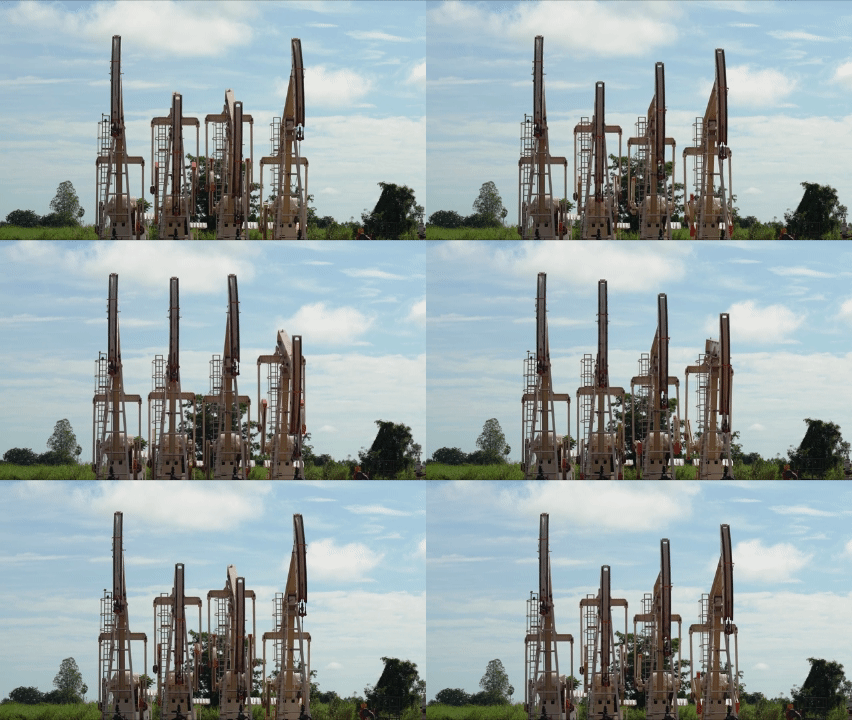
This paper proposes a novel, real-time pump failure prediction method using machine learning with scaled load ratio to accurately predict pump failures using only surface pump load data.

Five agreements target more than 11 Tcf of offshore gas and include flare-reduction technology.
-
 Fast-declining, older, unconventional oil wells require artificial lift experts to deal with and explore a population of miles-long horizontal wells that do not follow the established rules of thumb.
 -
The results of numerical simulations for the Lost Hills field were not successful because of the special characteristics of its diatomite reservoirs—low permeability but high porosity, weak rock strength, and strong imbibition.
-
This paper proposes a new method of economic prediction on the basis of expert library and oilfield databases. The method takes into account geological factors and the effect of production factors on the economic prediction.
-
Despite a trend toward renewables and low-carbon energy production among European majors, Total remains wholeheartedly committed to deepwater production.
-
Researchers from Chevron are looking into a new approach to understand the drivers of polymer hydration. How might this affect the design of mixing systems in the field, and could it affect offshore EOR applications?
-
The benchmark comes as operator Eni solidifies concession agreements and ramps up exploration and development in the North African country.
-
A company is selling a new well testing tool designed to be a cheaper, simpler way to do fiber optic sensing, and then it fades away.
-
A marked change from a decade ago, Appalachia, the Permian, and the Haynesville now represent almost half of total US gas production, EIA reports.
-
Production from older wells in the Permian Basin is declining faster than widely assumed, according to a new study. If this trend holds, it could lead to problems for companies that are depending on those wells to pay for future development or to justify a big acquisition.
-
BP has seen enormous payoff from a program to intervene in underperforming subsea wells in the Gulf of Mexico.