Production

In the fourth development phase, a planned tieback would connect resources from two North Sea discoveries to existing infrastructure at the Johan Sverdrup field, pending project sanction.
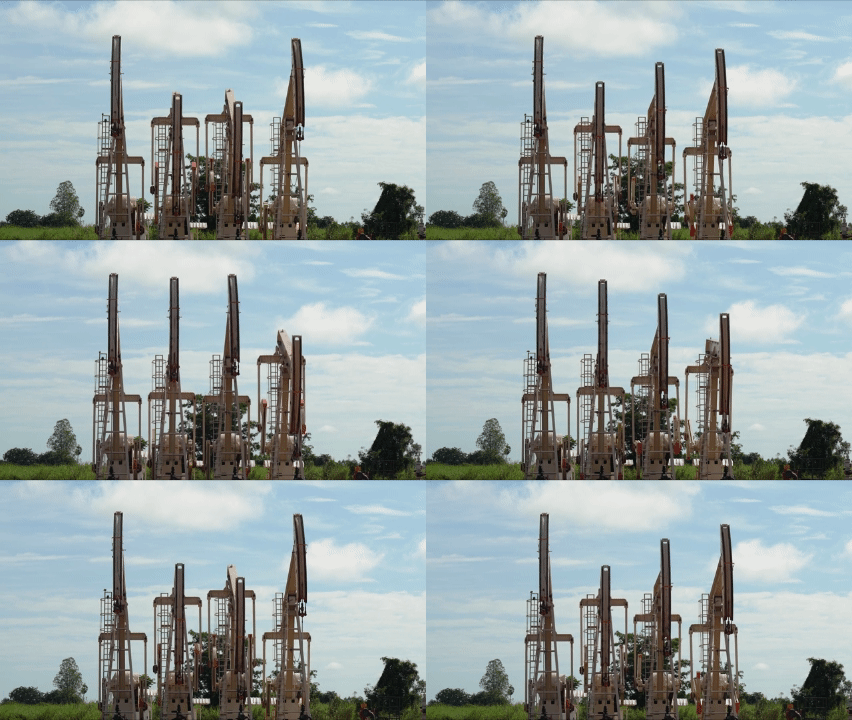
This paper proposes a novel, real-time pump failure prediction method using machine learning with scaled load ratio to accurately predict pump failures using only surface pump load data.

Five agreements target more than 11 Tcf of offshore gas and include flare-reduction technology.
-
The evolution of horizontal drilling and multistage completions has changed matrix stimulation from the “more acid, better result” belief to effective lateral distribution and deeper penetration with less acid.
-
 The complete paper describes a recent directional coiled-tubing drilling (DCTD) job completed for an independent operator in the Appalachian Basin.
 -
Sustainable cost reductions through innovation and standardization will have more of a positive effect on the offshore sector than cyclical oil-price increases, an OTC panel of industry participants agreed.
-
As it works to increase production to 1 million BOE/D, Permian mainstay Pioneer is taking a methodical approach to sustaining capital efficiency.
-
Subsea pumps are used for gas/liquid separation, subsea compression, and subsea boosting. Solutions aiming at cost reductions are crucial to make subsea processing projects feasible. A cost- and complexity-reduction solution for the subsea electrical power supply is a critical consideration.
-
More gas is flowing from Egyptian waters and the Eastern Mediterranean with BP’s launch of its Atoll Phase One project.
-
The case history presented in the complete paper describes the performance of an acid-fracturing intervention in an HP/HT well in which this intervention was the last procedure considered to evaluate the productivity of a Marrat Formation well.
-
Anadarko aims to maximize immediate short-cycle value through tiebacks and platform relocations in the Gulf of Mexico.
-
Corrosion inhibitors are often the first line of defense against internal corrosion, and effective mitigation relies on proactive monitoring and management of these inhibitors to allow for regular feedback and dose adjustment.
-
There are two ongoing trends in the industry. The first is an increasing wave of digitization. Second, piggybacking on the increased access to sensor and equipment data, analytics and artificial intelligence are on an exponential rise in the industry.