Production

In the fourth development phase, a planned tieback would connect resources from two North Sea discoveries to existing infrastructure at the Johan Sverdrup field, pending project sanction.
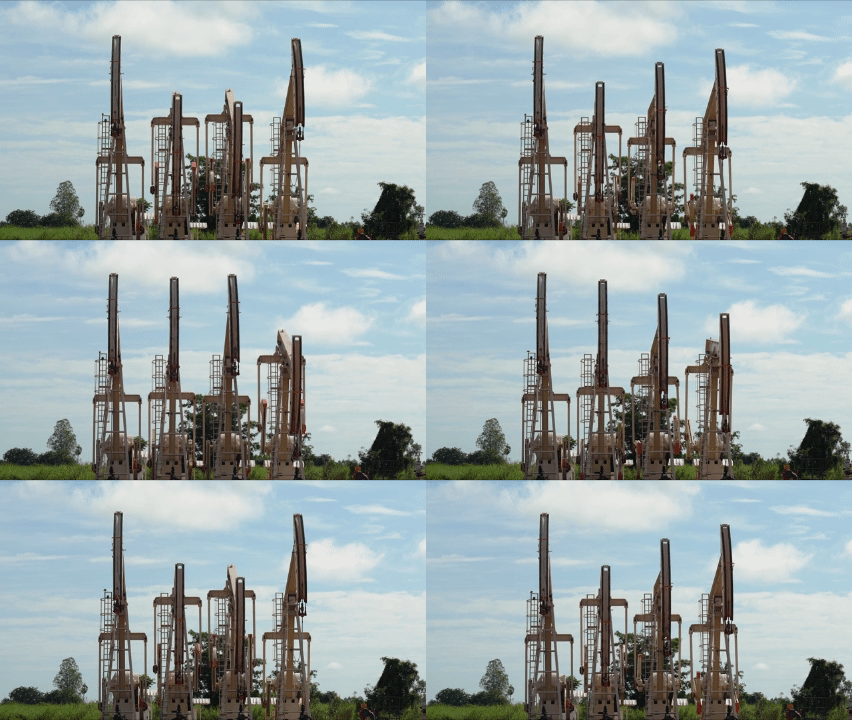
This paper proposes a novel, real-time pump failure prediction method using machine learning with scaled load ratio to accurately predict pump failures using only surface pump load data.

Five agreements target more than 11 Tcf of offshore gas and include flare-reduction technology.
-
 A matured field is currently producing with greater than 85% water cut (WC) and has significant levels of uncertainty with respect to oil/water contact (OWC), flank structure, depth of spill points, production allocation, and residual oil saturation.
 -
One of the most promising targets for resource-rock stimulation in South America is the Vaca Muerta (VM) shale in western Argentina.
-
A challenging commodity price environment has forced operators to seek methods for sharply lowering recovery cost per barrel of oil equivalent (BOE) in unconventional plays.
-
In a riserless-light-well-intervention (RLWI) operation in the Gulf of Mexico (GOM), a crown plug failed to release.
-
As part of a project that involves the use of four artificial islands to drill and complete more than 300 extended-reach-drilling (ERD) wells in a giant offshore oil field, several completion designs have been piloted for brownfield development.
-
Although refracturing is a topic that has gained a lot of interest, many shale producers have been sitting on the sidelines because early results did not justify the spending
-
Liquid loading is a common production problem in mature gas wells. Correct prediction of the critical gas velocity at which the well starts to load is very important for taking action to prevent premature loss of production.
-
A panel of experts says US shale producers need to rethink their drilling and completion designs as problems mount for horizontal wells when they go on pump. Hanging in the balance is whether long-term production from many shale wells will be achievable.
-
Chemical sand consolidation works by pumping chemicals downhole to strengthen the formation and stop sanding. In most cases reported in the industry, chemical consolidation has been used in short production intervals (less than 100 m).
-
Production engineers are often asked to manage both the artificial lift (AL) system and the upstream chemical injection program for a project.