Reservoir characterization

Known as Arena, the collaboration aims to improve decision-making across increasingly complex reservoirs and growing volumes of subsurface data.

Three papers are highlighted as the primary contributions because of their broad industry relevance. They focus on improving formation particle-size characterization, expanding the application of openhole gravel packs in depleted and compartmentalized reservoirs, and advancing the understanding of capillary pressure in sand production.

By integrating experimental and mathematical modeling approaches, this work aims to advance the understanding of sand-detachment dynamics and formation instability under varying saturation conditions.
-
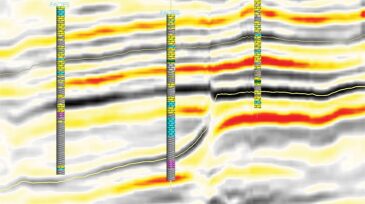
 This paper describes interpretation results of a 4D seismic-monitoring program in a challenging Middle East carbonate reservoir.
 -
This paper discusses a project with the objective of leveraging prestack and poststack seismic data in order to reconstruct 3D images of thin, discontinuous, oil-filled packstone pay facies of the Upper and Lower Wolfcamp formation.
-
Production growth in the Permian Basin requires drill rigs running at a high pace. That is challenging companies to push well productivity.
-
Electromagnetic images can show where water flows during a hydraulic fracture. A test in the Anadarko Basin showed a fault there was a bigger hazard than expected.
-
Diagnostic fracture injection tests (DFITs) incur direct and indirect costs resulting from the tests themselves and the extended time required for the pressure falloff, which delays the completion of the well. The benefits, therefore, must outweigh the costs if the test is to be justified.
-
Using drilling data and a downhole acoustic signal, developers aim to assess unconventional fracture networks in real time and give engineers ability to customize each stage.
-
BP announced four discoveries in the Gulf of Mexico near existing platforms. It use advanced seismic imaging to identify resources in deepwater locations that can be developed cost effectively using platforms nearby.
-
This paper presents an interdisciplinary approach to the description of tectonic dislocations made on the basis of interpretation of seismic data, petrophysical analysis of well-logging data in horizontal wells, and inversion of a multifrequency propagation tool.
-
This paper describes a case study of the Chonskaya group of fields to demonstrate an approach to the integration of time-domain-electromagnetic (TDEM) electrical and seismic data when building a geological model for improving reservoir-property and -saturation prediction.
-
In the clustered-development approach, the geologic dependence between prospects is combined with the aggregation of prospects to determine the economic viability of a grassroots development offshore.