Reservoir simulation

Known as Arena, the collaboration aims to improve decision-making across increasingly complex reservoirs and growing volumes of subsurface data.
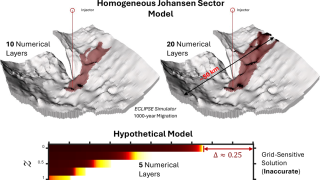
A new framework combines analytical and numerical insights, extending vertical equilibrium modeling and guiding reservoir-scale implementation, providing reservoir engineers with practical guidance for assessing accuracy across flow regimes and long-term carbon-dioxide migration.

This article from the SPE Integrated Reservoir Management Technical Section (IRMTS) examines the closed-loop IRM approach, from insight to execution to learning, and the limits of technology-driven solutions.
-
 The complete paper demonstrates the benefits of honoring data measurements from a multitude of potential sources to help engineers do a better job of including more diagnostics into routine operations to provide additional insight and result in improved models and completion designs.
 -
Most history-matching studies have fixed resources—that is, the team of engineers and geoscientists is predetermined. Moreover, the deadlines are always very strict. This constrained scenario often leads to an unfortunate result: The quality of the study suffers.
-
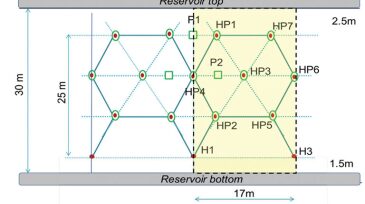
Proper lateral and vertical well spacing is critical for efficient development of unconventional reservoirs. Much research has focused on lateral well spacing but little on vertical spacing, which is challenging for stacked-bench plays such as the Permian Basin.
-
The complete paper explores the use of multilevel derivative-free optimization for history matching, with model properties described using principal component analysis (PCA) -based parameterization techniques.
-
The Russian company has built a computing cluster in St. Petersburg designed to generate digital twins of oil fields. The new distributed-computing system is capable of processing more than 100 gigabits per second, speeding up the digital-modeling process five-fold.
-
In my view, we still do not possess a full understanding of oil production in unconventional fractured reservoirs. Our ability to forecast such assets remains elusive, even with copious amounts of analytics, mountains of data, and an arsenal of machine-learning tools.
-
In this paper, the authors show the limitation of CEOS for modeling reservoir behavior of liquid-phase black and volatile oil in highly undersaturated reservoirs.
-
In this work, the authors developed a numerical model of in-situ upgrading (IU) on the basis of laboratory experiences and validated results, applying the model to an IU test published in the literature.
-
Machine-learning methods have gained tremendous attention in the last decade. The underlying idea behind machine learning is that computers can identify patterns and learn from data with minimal human intervention. This is not very different from the notion of automatic history matching.
-
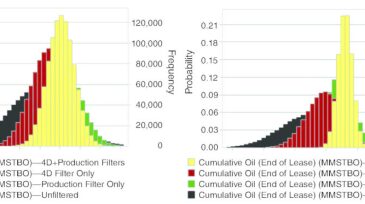
This paper outlines the value of 4D for reducing uncertainty in the range of history-matched models and improving the production forecast.